
Years ago, a young man sat in my chair after getting a quick trim somewhere across town. He’d been happy with it for about a day. Then his girlfriend snapped a photo of him from behind at a ballgame, and he saw something he’d never noticed in the bathroom mirror.
The back of his head had a shelf. A hard ridge of hair stuck out just above his neckline, like the brim of a cap he wasn’t wearing. The sides looked fine from the front. The top looked fine too. But from behind, the whole shape tipped off balance.
“I look like I’ve got a ledge back there,” he said, half laughing, half embarrassed.
I turned the chair, held up the hand mirror, and let him look. He went quiet. I noticed this happens a lot. Most of us only know our own heads from one direction, and the other views can feel like meeting a stranger.
The Mirror Only Tells Half the Story
The Client Who Only Saw the Front
Balance Lives in the Round
Think about how people actually see you. Your coworker sees your profile in a meeting. The guy behind you in line sees the back of your neck. Your kid on your shoulders sees the top of your head. Your friends at a barbecue catch you from every angle as you move around.
A good cut has to hold up through all of that. That is the quiet truth behind balance. A haircut is closer to a sculpture than a painting. It has a front, two sides, a back, a top, and countless angles in between. If even one view drifts, the whole piece can feel slightly off, even if people can’t say why.
Perhaps that’s why some cuts feel “right” without anyone being able to explain it. The shape simply makes sense from wherever you stand.
What This Guide Will Help You Notice
This guide isn’t meant to make you an expert with the clippers. It’s meant to help you see your own head the way a master barber sees it. By the end, you’ll understand:
- How balance differs from symmetry, and why perfect symmetry is rarely the goal
- The science behind why your brain notices a lopsided shape so quickly
- What changes in the front, side, back, and top views
- How skilled cutters build balance step by step
- Which mistakes tend to show up a week or two later
- How to protect a balanced shape between visits
It seems fitting to start with the most common misunderstanding of all: the idea that balanced means identical.
Balance Is Not the Same as Symmetry
Why No Head Is a Perfect Match
Here’s something I wish every man knew before he sat down: nobody’s head is perfectly even. Not yours, not mine, not the guy on the magazine cover.
Facial anthropometry research, including the long-running measurement work of Dr. Leslie Farkas, has shown that small differences between the left and right sides of the face are completely normal. One ear may sit a little higher. One cheekbone may be fuller. One eyebrow may arch more.
Hair follows the same rule. Your hairline might recede a touch more on one temple. Your crown may spiral off-center. One side may grow faster or thicker than the other.
So if a cutter tried to make both sides exactly the same length, measured with a ruler, the result might actually look less even. Hair sitting on an uneven foundation needs small adjustments to appear level.
Symmetry vs. Balance
| Factor | Symmetry | Balance |
| Definition | Both sides are mirror images | Both sides look equal in weight and shape |
| Method | Equal measurements left and right | Adjusting to the head underneath |
| Result on uneven heads | Can exaggerate differences | Hides small differences |
| Flexibility | Rigid | Adaptable |
| Works with side parts | Rarely | Yes |
| Best mindset | Ruler and math | Eye and judgment |
A side part is a good example. It’s deliberately asymmetrical. One side holds more hair than the other. Yet a well-cut side part looks balanced because the visual weight feels settled, like a well-loaded truck bed where nothing slides around.
Visual Weight and Where the Eye Lands
Visual weight is how much attention a part of the cut draws. Longer hair, darker hair, sharp lines, and bulk all carry more visual weight. Short, faded, soft areas carry less.
When visual weight is spread sensibly, the eye moves comfortably around the head. When too much piles up in one spot, the eye gets stuck there. That’s when people notice the puffy side, the heavy crown, or the sideburn that looks longer than its partner.
I sometimes think of it like a coach setting a defense. You don’t need every player in the same place. You need them spread so no gap opens up.
That idea of proportion didn’t start in barbershops, of course. People have been chasing it for thousands of years.
How Barbers Have Chased Proportion Through the Years

Classical Proportions and the Rule of Thirds
Ancient Greek sculptors and Renaissance artists studied the human face obsessively. Leonardo da Vinci sketched faces divided into equal thirds: hairline to brow, brow to nose tip, and nose tip to chin. Many artists also leaned on the golden ratio, roughly 1.618 to 1, as a guide for pleasing proportions.
Barbers inherited those ideas, whether they knew it or not. When I raise or lower the height on top of a man’s head, I’m often adjusting that top third of the face. A long forehead might call for a little fringe. A short one might welcome height.
Mid-Century Precision in the Shop
The barbershops of the 1940s and 1950s were temples of precision. Clean white tunics, glass jars of blue disinfectant, the smell of tonic and talc. Barbers trained to cut flattops so level you could set a coffee cup on them.
My first mentor came up in that era. He used to step back, squint, and tilt his head like a carpenter checking a frame. “Hair doesn’t lie,” he’d say. “If it’s off, your eye knows before you do.”
From Flattops to Fades to Textured Crops
| Era | Signature Style | Balance Challenge | How Barbers Solved It |
| 1920s to 1940s | Slick side parts | Even shine and part line | Pomade and careful combing |
| 1950s | Flattop, crew cut | Perfectly level top | Flat combs, steady clipper work |
| 1960s | Ivy League, mod cuts | Even layering | Scissor-over-comb |
| 1970s | Feathered, longer layers | Matching both sides of the face | Razor cutting and blow-drying |
| 1980s | Hi-top fade | Tall, even geometry | Sculpting from every side |
| 1990s | Caesar, buzz cut | Uniform length | Guards and steady passes |
| 2000s | Faux hawk, spikes | Center ridge alignment | Sectioning down the middle |
| 2010s | Skin fades, pompadours | Seamless blending all around | Multiple guards, constant checking |
| 2020s | Textured crops, modern mullets | Balance in loose, natural shapes | Dry cutting and 360-degree checks |
I noticed something looking back over these eras. The styles changed, but the core question never did: does this shape make sense from every side? That question, it turns out, has roots in how our brains process what we see.
The Science of Seeing a Shape
Why the Brain Notices Imbalance So Fast
Psychologist Gillian Rhodes of the University of Western Australia has published widely on how people perceive faces, and her research has found that people tend to rate more symmetrical faces as more attractive. We’re wired to notice when something looks lopsided.
That same instinct applies to hair. A sideburn that’s an eighth of an inch longer on one side can catch someone’s eye from across the room. They may not know what bothers them. They simply feel that something’s off.
Perhaps that’s why balance matters more than most men realize. It works quietly in the background of every first impression.
A Head Is a Sphere, Not a Photograph
A bathroom mirror flattens your head into a picture. In real life, your head is a rounded shape that curves away from the viewer in every direction.
That curve changes how hair sits. Hair over the round parts of the skull sticks out more. Hair over flatter areas lies closer. A guard that looks even on the sides might look uneven at the back, simply because the skull curves differently there.
It’s a bit like painting a basketball. A straight stripe looks straight from one angle and curved from another. Good cutters account for the curve so the shape reads smoothly from any side.
Light, Shadow, and Contrast
Light plays a huge role. A fade looks smooth only if the shadows blend gradually. A sharp line between light and dark catches the eye, which is why a poorly blended fade shows a “line” even when the lengths are close.
| Visual Cue | What the Eye Reads | Effect on Balance |
| Smooth shadow gradient | Gradual change | Looks seamless |
| Hard shadow line | Sudden change | Draws attention, looks uneven |
| Matching contrast on both sides | Even weight | Feels balanced |
| More contrast on one side | Uneven weight | Feels lopsided |
| Shine on one spot | Highlight | Pulls the eye there |
Knowing this science is helpful, but every balanced cut really begins before the clippers ever switch on.
Reading the Head Before the First Pass
Head Shape, Flat Spots, and Bumps
When a new client sits down, I usually run my fingers across his scalp before anything else. Some guys think it’s a strange habit. But I’m feeling for the terrain: flat spots, bumps, ridges, and dips.
| Head Shape Feature | Common Challenge | Balancing Approach |
| Flat back of head | Back looks scooped | Leave more length at crown and occipital area |
| Prominent occipital bone | Shelf forms at the back | Fade carefully below and blend over the bump |
| Narrow head | Sides look thin | Keep a bit more length at sides |
| Wide head | Looks boxy | Tighter sides, more height on top |
| Ridges or dents | Uneven shadows | Adjust guard length locally |
| Long, oval head | Can look tall | Avoid excessive height on top |
A flat spot at the back, often from sleeping on one side as a baby, is very common. Cutting it with the same guard as the rest of the head can make it look even flatter. Leaving a touch more length fills it in.
Cowlicks, Whorls, and Growth Patterns
Hair doesn’t grow straight up like grass. It grows at angles, often in spirals. The most famous spiral is the crown whorl. Geneticist Amar Klar’s 2003 research found that clockwise crown whorls are far more common than counterclockwise ones, and a smaller share of people have two whorls.
Cowlicks are patches of hair growing against the surrounding direction. They often show up at the front hairline or crown.
| Growth Pattern | Where It Shows | What Happens If Ignored | Better Approach |
| Crown whorl | Back of the top | Hair sticks up or parts open | Leave enough length to lie flat |
| Front cowlick | Hairline | Fringe flips up | Work with the direction, not against it |
| Double crown | Two spirals at crown | Uneven gaps | Extra length or very short |
| Neck whorl | Nape | Neckline looks crooked | Taper rather than block |
Cutting against these patterns is like trying to steer a canoe upstream. You can do it, but it’s tiring and never quite works.
Ears, Jawlines, and Uneven Features
Ears often sit at slightly different heights. If I cut a perfectly level line above each ear without noticing, one side will look higher. So I follow the ears, then step back and check from the front.
The jaw matters too. A strong, square jaw can handle tight sides. A softer jaw might benefit from a little more length or a beard to create structure.
I noticed that men rarely know these things about themselves. When I mention that their left ear sits lower, they often laugh. “Is that why my glasses always tilt?” Perhaps it is.
With the head read and understood, let’s start where most people look first: straight on.
The Front View: Framing the Face
Fringe and Hairline Framing
From the front, hair acts like a picture frame around the face. The fringe, temples, and sides decide how the face reads.
A heavy fringe shortens a long face. A swept-back style lengthens a shorter one. Soft temples can hide a receding hairline, while hard corners can draw attention to it.
According to the American Hair Loss Association, about two-thirds of American men experience some noticeable hair loss by age 35. Many of those changes begin at the temples, so front-view balance often means framing the hairline gently rather than carving a sharp, unforgiving line.
Matching One Side to the Other
From the front, I’m looking at both sides at once. Are they the same width? Do they fade at the same height? Do the sideburns end at the same point?
To check, I’ll stand directly behind the client and look into the mirror, then step in front and look straight at him. Sometimes I’ll use the bridge of the nose and the center of the eyebrows as a reference. It’s the same way a picture framer uses a level, except my level is a set of features that aren’t perfectly level themselves.
Height vs. Width
| Face Shape | Front View Goal | More Height or More Width? | Example Styles |
| Round | Add length, slim sides | Height | Quiff, textured pompadour |
| Square | Soften or show off angles | Moderate height | Side part, crew cut |
| Oval | Keep proportions even | Either | Most styles |
| Long or oblong | Reduce length | Width, some fringe | Fringe crop, Caesar |
| Diamond | Fill forehead and chin areas | Width at top | Textured fringe |
| Heart | Balance wide forehead | Less height | Side-swept fringe |
Height and width work like a seesaw. Add height and the face looks longer and slimmer. Add width and it looks shorter and broader. The goal is to settle that seesaw where it feels right for your features.
The front is only one view, though. Turn your head, and a whole new story appears.
The Side Profile: Where Weight Lines Live
Placing the Weight Line
The weight line is where the longer hair on top meets the shorter sides. From the side, it’s one of the first things the eye notices.
Too high, and the head can look narrow or top-heavy. Too low, and the sides can look bulky. Where it belongs depends on head shape, face shape, and style. On a round head, a slightly higher weight line can slim the profile. On a narrow head, a lower one can add fullness.
Low Fade vs. High Fade
| Factor | Low Fade | High Fade |
| Starting point | Just above the ear and neckline | High on the sides, near the temples |
| Overall look | Subtle, conservative | Bold, high contrast |
| Effect on profile | Keeps width | Slims and lengthens |
| Best for | Narrow heads, professional settings | Round faces, statement styles |
| Grow-out | Graceful | Shows faster |
| Risk | Can look bulky on dense hair | Can expose bumps on the skull |
I usually ask a client how he spends his week. A man in a suit might lean toward a low fade. A college athlete might want a high fade that looks sharp under a helmet. Neither is better. Perhaps the right one simply fits the life it’s going to live.
The Space Around the Ear
The area around the ear is where balance quietly breaks down. If the outline curves differently on each side, people notice, even if only subconsciously.
I’ll fold each ear forward gently, clean the outline, then check both sides against each other in the mirror. A steady hand helps, but a patient eye helps more. It’s a bit like a father teaching his kid to tie his shoes: slow, even loops on both sides, or the whole thing comes undone.
From the side, we’ve seen how weight sits. But the angle most men never see at all is the one behind them.
The Back View: The Angle You Never See
The Crown and Its Stubborn Spiral
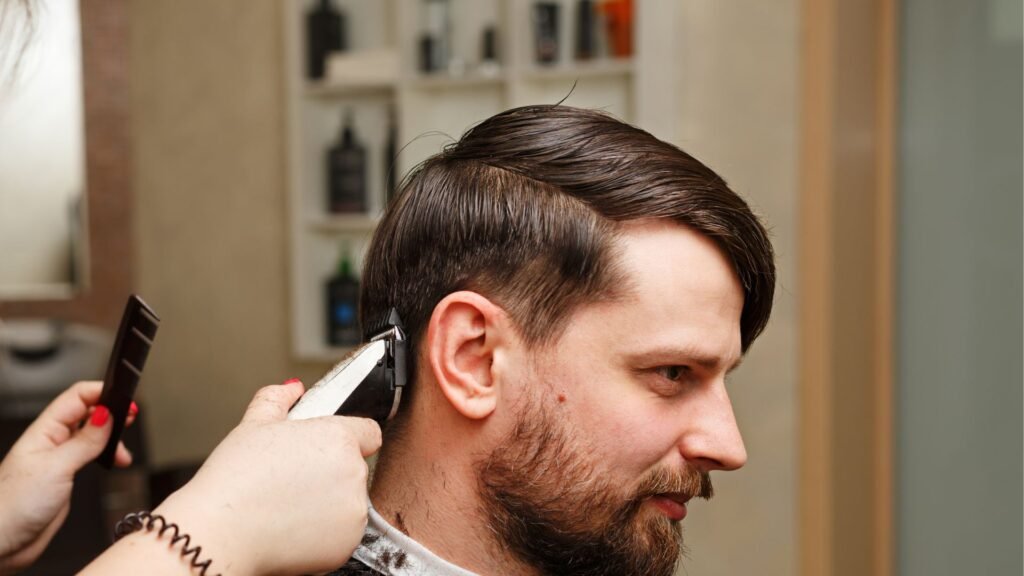
The crown is where many cuts lose their balance. Because hair spirals out from the whorl, it can stick up, part open, or lie flat in odd directions.
Cut the crown too short, and the hair stands up like a rooster tail. Leave it too long on one side, and the spiral creates a lopsided bump. The right length depends on how strongly the whorl spins.
Blocked vs. Tapered Necklines
| Factor | Blocked Neckline | Tapered Neckline | Rounded Neckline |
| Look | Sharp, squared | Soft fade into skin | Curved corners |
| Effect on neck | Can look wider | Looks slimmer, longer | Softens a square neck |
| Grow-out | Shows fuzz fast | Grows out gracefully | Moderate |
| Best for | Thick necks, crisp styles | Most men, especially uneven hairlines | Medium styles |
| Maintenance | Every 1 to 2 weeks | Every 3 to 4 weeks | Every 2 to 3 weeks |
If your natural neck hairline grows unevenly, a blocked line can make that unevenness obvious. A taper follows the growth and hides small differences.
Working With the Occipital Bone
The occipital bone is the bump at the back of your skull. It’s the widest point of the back of the head.
If a fade line sits right on that bump, it can create a shelf, like the one my young client saw in his ballgame photo. Blending smoothly over the bump, or placing the transition just above or below it, keeps the back looking rounded and natural.
I sometimes tell clients it’s like driving over a speed bump. Slow down, ease over it, and nobody spills their coffee.
The back view matters, but so do the angles in between, and the one from above.
The Top View and the Three-Quarter Angles
The Bird’s-Eye Check
Most people don’t look at the top of your head. But kids on your shoulders do. So do taller friends, and anyone standing on a staircase above you.
From above, I’m checking that the top looks even, the part sits straight, and the length flows smoothly from front to back. I’ll often stand on the chair’s footrest or lower the chair to get this view. A crooked part or a dip in the length shows up clearly from above.
Three-Quarter Views and Real-Life Glances
Here’s something I find interesting. In real life, people rarely see you straight on or in perfect profile. They see you from a three-quarter angle, somewhere between front and side.
| Factor | Mirror View | Camera or Real-Life View |
| Orientation | Reversed left to right | True orientation |
| Angles seen | Mostly front | Every angle |
| Lighting | Usually fixed | Constantly changing |
| What it hides | Back, crown, three-quarter angles | Very little |
| Common surprise | “It looked fine at home” | “Is that what I look like?” |
This is why some men feel strange seeing themselves in photos. The mirror shows a flipped image, and the camera shows the real one. A balanced cut should look good both ways.
Square Corners vs. Rounded Corners
The corners are where the top meets the sides, often around the temples and the back of the crown.
| Factor | Square Corners | Rounded Corners |
| Look | Structured, geometric | Soft, natural |
| Best for | Flattops, crew cuts, strong jaws | Most face shapes, textured styles |
| Effect from three-quarter view | Sharp outline | Smooth flow |
| Grow-out | Loses shape quickly | Grows out gracefully |
| Risk | Can look boxy on round heads | Can look soft on square styles |
So how does a skilled cutter keep all these angles in check? It usually comes down to a process.
How a Skilled Barber Builds Balance Step by Step
Sectioning and Guidelines
Balance starts with structure. Before I cut anything, I divide the head into sections: top, sides, back, and crown. Then I set a guideline, a first cut that every other section follows.
Here’s a simplified version of the process:
- Consult and agree on the shape and length
- Read the head, feeling for bumps, whorls, and flat spots
- Section the hair into zones
- Set the guideline on one side
- Mirror the guideline on the other side
- Blend the sides into the back
- Connect the top to the sides
- Detail the edges and outline
- Check from every angle
It’s like building a deck. Set the first board straight, and the rest follow. Set it crooked, and you’ll be fixing it all afternoon.
Cross-Checking and the Wet vs. Dry Question
Cross-checking means cutting in one direction, then checking in the opposite direction. If I cut the top front to back, I’ll check it side to side. This catches uneven lengths the first direction hides.
| Factor | Wet Check | Dry Check |
| Shows precise lengths | Yes | Less so |
| Shows true shape | No, hair clumps | Yes |
| Reveals growth patterns | Partly | Fully |
| Best for curly hair | Low accuracy | High accuracy |
| Catches bulk and gaps | Rarely | Usually |
I almost always check both. Wet tells me the lines are clean. Dry tells me whether the shape actually belongs on that head.
The Final Walk-Around
When the cutting is done, I do a slow walk around the chair. Front. Left side. Back. Right side. Then the three-quarter angles. Then I tilt the chair and check from above.
I’ll also ask the client to turn his head and look down, the way he might at his phone. Sometimes the hair shifts in a way it doesn’t when he sits upright.
It seems simple, but this walk-around is where many small fixes happen. A stray hair above the ear. A sideburn a hair too long. A soft spot at the crown. Small things, but they add up.
The process matters, but so do the tools in the cutter’s hands.
The Tools Behind a Balanced Shape
Clippers vs. Scissor-Over-Comb
| Factor | Clippers | Scissor-Over-Comb |
| Speed | Fast | Slower |
| Evenness | Very consistent with guards | Depends on skill |
| Blending | Excellent for fades | Excellent for soft transitions |
| Following head shape | Limited by guard length | Adjusts to every curve |
| Best for | Short sides, uniform lengths | Medium lengths, tricky head shapes |
| Sound and feel | The familiar buzz | The quiet snip of steel |
Clippers give consistency. Scissor-over-comb gives control. On a head with bumps or flat spots, I often switch to scissors because I can adjust length millimeter by millimeter as the skull curves.
Guards, Combs, and the Hand Mirror
Guards create even lengths, but only if the cutter keeps the angle steady. Tilt the clipper slightly, and one side ends up shorter.
Combs act as guides. A wide-tooth comb lifts hair for scissor work. A fine-tooth comb helps with precision and checking.
And then there’s the humble hand mirror. It’s not just for showing the client the back at the end. I use it during the cut to see angles I’d otherwise miss.
Why Lighting Changes Everything
Bright, even lighting reveals uneven blending. Dim or one-sided lighting hides it until you step outside into the sun.
Good shops use overhead lights that wash the whole head evenly. Some cutters also step back to check the cut under different light. I once had a client say his cut looked perfect in the shop and completely different in his car’s rearview mirror. Perhaps the light just told a different story.
Tools and light matter, but your hair type and the weather around you shape balance too.
Hair Type, Texture, and Weather
Straight and Fine Hair
Straight hair shows every line. A small step in the blending or a slightly uneven length is easy to see. Fine hair can also separate and reveal the scalp, so balance often means leaving enough weight to keep the surface smooth.
Wavy, Curly, and Coily Hair
| Hair Type | Balance Challenge | Best Approach |
| Straight, fine | Shows every line | Precise blending, careful weight |
| Straight, coarse | Sticks out at sides | Tighter sides, debulking |
| Wavy | Uneven wave pattern | Cut dry, check movement |
| Curly | Shrinkage changes length | Cut dry, shape the silhouette |
| Coily | Dense, even shape needed | Sculpt evenly, check all angles |
Curly and coily hair can shrink significantly as it dries. Cutting it wet and assuming the length will stay can lead to surprises. Shaping it dry lets me see the real silhouette, a bit like fitting a jacket while you’re wearing it rather than while it hangs on a rack.
Humidity, Seasons, and Shape Shifts
According to Clarence Robbins’ textbook Chemical and Physical Behavior of Human Hair, hair can absorb roughly 30 percent of its weight in water. When that happens, strands swell and change shape, which is why your cut can look different on a damp morning.
Humidity Change can quietly undo balance. Wavy hair gets wavier. Curls tighten. Straight hair may puff out at the sides. A cut that looked perfect in the dry air of the shop might look heavier on one side after a humid afternoon.
| Weather Condition | Effect on Hair | Balance Tip |
| High humidity | Swelling, frizz, puffiness | Remove a little extra bulk at sides |
| Dry winter air | Static, flyaways | Use light moisturizing products |
| Rain | Curls tighten, waves form | Choose styles that embrace texture |
| Hot, sweaty summer | Hair flattens or clumps | Shorter sides, matte finish |
I sometimes ask clients where they’re headed. A man moving to a humid coastal city might need a slightly different shape than one living somewhere dry. It seems a small question, but it can change the whole plan.
Even with all this knowledge, mistakes still happen. Here are the ones I see most.
Balance Mistakes That Show Up Later
Chasing One Side Into the Ground
This one is common. A cutter notices one side looks longer, trims it, then the other side looks longer, so he trims that one. Back and forth, back and forth, until both sides are much shorter than planned.
It’s like adjusting a picture frame on the wall. Nudge it left, it’s crooked. Nudge it right, still crooked. The better move is to step back, look at the whole wall, and make one calm adjustment.
Mismatched Sideburns
Sideburns are small but powerful. If one ends at the middle of the ear and the other a bit lower, it can throw off the entire face.
Because ears often sit at different heights, using the ear as the only guide doesn’t always work. I check sideburns against the cheekbone, the eye, and in the mirror from the front.
The Hidden Hole at the Crown
A crown cut too short can open up a gap where the whorl spirals. The client might not see it, but everyone behind him will.
Once it’s cut too short, the only fix is time. The American Academy of Dermatology notes that hair grows about half an inch a month, so a crown hole can take a few weeks to fill in.
Ignoring How Hair Wants to Grow
| Mistake | What You’ll Notice | The Fix |
| Cutting against a cowlick | Hair flips up within days | Leave length to weigh it down |
| Fade line on the occipital bump | Shelf at the back | Blend above or below the bone |
| Blocked neckline on uneven growth | Crooked neck edge | Switch to a taper |
| Same guard over a flat spot | Back looks scooped | Leave more length there |
| Only checking the front | Surprises in photos | Do a full walk-around |
| Uneven ear outlines | Lopsided profile | Check both ears side by side |
These mistakes make more sense when you see them play out with real people.
Stories From the Chair
The Groom and His Wedding Photos
Marcus came in a week before his wedding. He wanted to look sharp, but he was nervous. “The photographer’s going to shoot me from every angle,” he said. “I don’t want any surprises.”
We spent extra time on the walk-around. I checked his crown from above, blended carefully over his occipital bone, and matched his sideburns three different ways. A week later, his mother-in-law emailed a photo of him from the side, laughing during the toast. Every line held.
The Father and Son on Saturday Morning
A father brought in his twelve-year-old son, both wanting matching fades. The dad had a rounder head and a strong crown whorl. The boy had a narrow head and a flat spot at the back.
Same style on paper. But I adjusted the fade height for each. The dad got a slightly higher fade to slim his profile. The boy kept more length at the back to fill the flat spot. When they stood side by side in the mirror, they looked like father and son wearing the same style, and they both grinned the exact same way.
The Gift Card for Grandpa
A granddaughter bought her grandfather a gift card. He’d been going to the same quick-cut spot for years, always the same short back and sides.
He had a noticeable double crown that his old cuts kept chopping too short, leaving two little gaps. I left a bit more length there and tapered his neckline instead of blocking it. When he saw the back in the hand mirror, he chuckled. “Didn’t know I had a good side back there.”
He comes in every four weeks now, always with a story about his garden.
Stories like these often lead to practical questions about cost and upkeep.
Cost, Upkeep, and Keeping Balance Between Visits
What Precision Costs
| Service Type | Typical Time | Common Price Range | What You’re Paying For |
| Basic clipper cut | 15 to 25 minutes | $20 to $35 | Speed, uniform length |
| Standard cut with blending | 30 to 45 minutes | $30 to $50 | Balance on sides and back |
| Precision fade | 40 to 60 minutes | $40 to $65 | Seamless blending, detail work |
| Scissor cut with texture | 45 to 60 minutes | $45 to $70 | Shaping around head contours |
| Cut with beard detailing | 50 to 75 minutes | $55 to $90 | Full face and head balance |
Prices vary by city and experience. The U.S. Bureau of Labor Statistics projects steady demand for barbers and stylists over the coming decade, which suggests more men are choosing skilled, personal service over quick buzz-and-go visits.
How Balance Grows Out
| Weeks After the Cut | What Happens | Balance Status |
| Week 1 | Fresh, crisp lines | Perfect |
| Week 2 | Neckline softens, fade fills in | Still balanced |
| Week 3 | Sides start to puff, crown may lift | Starting to drift |
| Week 4 | Weight line blurs, edges fuzzy | Noticeably uneven |
| Week 5 and beyond | Shape loses structure | Time for a visit |
Because the American Academy of Dermatology notes hair grows about half an inch a month, short styles lose balance faster than longer ones. A skin fade might need attention every two weeks, while a medium-length scissor cut can last four to six.
Home Habits That Protect the Shape
Between visits, a few small habits help:
- Comb in the direction of growth, not against it
- Use the right amount of product, too much can weigh one side down
- Avoid trimming the neckline yourself unless you have a steady hand and two mirrors
- Sleep on a smooth pillowcase to reduce flattening on one side
- Book your next visit before you leave the shop
I noticed that men who book ahead tend to keep their shape longer. They never reach that week-five stage where everything drifts.
Where Balanced Styles Are Heading
Styles are moving toward softer, more natural shapes. Textured crops, modern mullets, and loose curls have become popular, partly because they forgive small imperfections. Still, they need careful balance, since loose styles can look messy instead of intentional if the weight isn’t distributed well.
Men are also more open about their hair. They ask about crowns, thinning, and head shape in ways they rarely did twenty years ago. That honesty makes it easier to build cuts that work from every side.
Finding the Right Chair
When you search for a haircut near me, it’s tempting to pick the closest shop with an open slot. But if balance matters to you, perhaps ask a few questions first:
- “Do you check the cut from every angle before I leave?”
- “How do you handle a crown whorl or a flat spot?”
- “Would a taper or a blocked neckline suit me better?”
- “Can you show me the back and top with a hand mirror?”
A cutter who cares about the craft will welcome those questions. You’ll hear it in how they answer.
Now let’s tackle the questions that come up most often in the chair.
Frequently Asked Questions
Why does my cut look good in the mirror but off in photos?
A mirror shows a reversed image and mostly the front view. Photos show your true orientation and angles you rarely see, like the three-quarter view and the back. If your cut was only checked from the front, those other angles may reveal uneven spots. Asking for a full walk-around during your visit can help.
Should both sides of my head be cut to the exact same length?
Not always. Most heads have small differences between sides, such as ears at different heights or uneven hairlines. A skilled cutter adjusts slightly to make both sides look equal, rather than measuring them as exactly equal. That’s the difference between symmetry and balance.
What causes a shelf or ledge at the back of my head?
A shelf usually forms when a fade or weight line lands right on the occipital bone, the bump at the back of your skull. Blending smoothly over that area, or placing the transition just above or below it, keeps the back rounded.
How can I tell if my crown was cut too short?
If hair sticks straight up or you can see a small gap where the spiral starts, the crown may be too short. Leaving a little extra length there helps the hair lie flat. If it’s already too short, give it two to four weeks to grow back.
Is a tapered or blocked neckline better for balance?
A tapered neckline usually grows out more evenly and hides an uneven natural hairline. A blocked neckline looks crisp but shows unevenness and regrowth faster. If your neck hair grows in odd directions, a taper is often the safer choice.
Does weather really affect how balanced my cut looks?
Yes. Hair absorbs water from the air, which makes it swell, curl, or frizz. A shape that looks even on a dry day can puff out unevenly on a humid one. Telling your cutter about your climate can help them adjust bulk and length.
How often should I get a trim to keep my cut balanced?
Short styles like skin fades usually need attention every two to three weeks. Medium styles last about three to four weeks. Longer styles can often go four to six weeks. The faster your hair grows, the sooner balance drifts.
Can a cut help balance an uneven face or head shape?
Absolutely. Adding length over flat spots, adjusting fade height for head width, and choosing the right fringe or height can make features look more even. A good cutter reads your head before cutting and plans around it.
With those answers in hand, let’s put everything together into a simple plan.
Your Balance Checklist and a Final Word
Before Your Next Visit
- Take a photo of the back and sides of your current cut
- Notice any spots that stick up or look uneven
- Feel for flat spots or bumps on your head
- Find your crown whorl with a hand mirror
- Think about your weekly routine and the climate you live in
- Ask your cutter to check every angle
- Discuss taper vs. blocked neckline
- Book your next visit before you leave
A Simple Self-Check at Home
| Angle | What to Look For | How to Check |
| Front | Even sides, matching sideburns | Stand straight in the mirror |
| Left side | Clean weight line, smooth fade | Turn your head, use a hand mirror |
| Right side | Matches the left side | Compare photos of both sides |
| Back | No shelf, even neckline | Use two mirrors or ask someone to snap a photo |
| Crown | No gaps or sticking up | Hand mirror from above and behind |
| Top | Even length, straight part | Photo from above |
| Three-quarter | Smooth flow from front to side | Take a photo at an angle |
A Final Word From the Chair
I keep thinking about that young man and his photo from the ballgame. He’d worn the same cut for days without knowing the back had a ledge. Perhaps that’s the quiet lesson in all of this: we only see part of ourselves, and the rest of the world sees the whole picture.
Balance isn’t about perfection. No head is perfectly even, and no cut needs to be. It’s about a shape that makes sense from wherever someone happens to be standing, across the table, behind you in line, or looking down from your shoulders.
You don’t need to memorize every technique here. Maybe just take a look at the back of your head next time, or ask your cutter to turn the chair one more time before you leave. Notice the buzz of the clippers, the smell of talc, the cool steel of the scissors near your ear. Watch how carefully the shape comes together from every side.
If any of this rings true for you, take it with you. If it doesn’t quite fit, that’s fine too. Every head is different, and after all these years behind the chair, I’m still learning something new from each one that sits down.