
The Mirror Doesn’t Lie, It Just Changes Its Mind
The Shower Beard vs. the Ten-Minute Beard
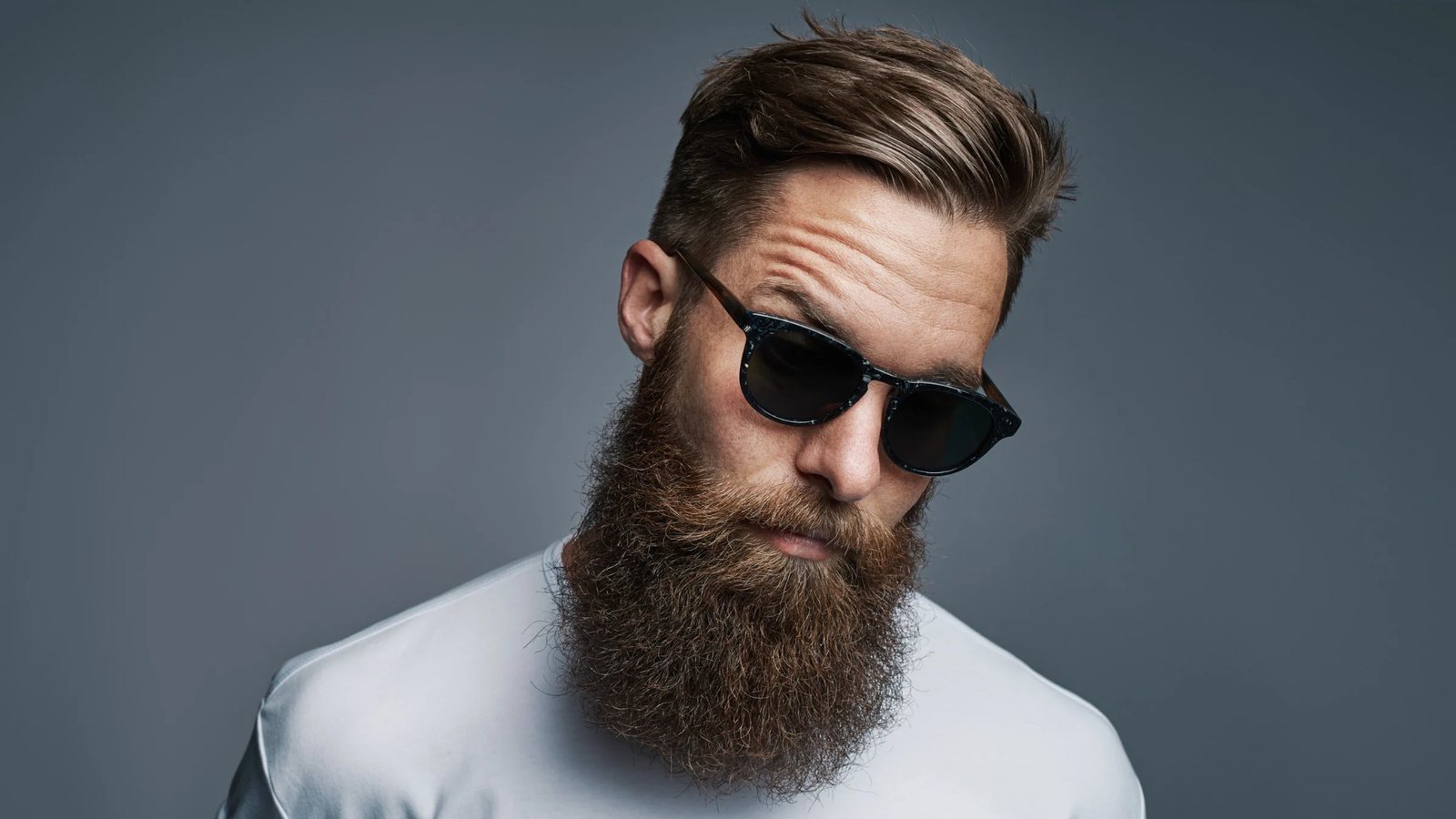
You step out of a hot shower. Steam fogs the mirror, so you swipe a hand across the glass and there it is: your beard, dark and sleek, hanging long and neat like it was drawn on with a fountain pen. Every hair is in line and the edges look sharp. For about thirty seconds, you’ve got the best beard in the zip code.
Then you towel off, brush your teeth, pour a cup of coffee, and glance back at the mirror ten minutes later.
Who is that guy?
The beard has shrunk. It’s puffed out at the cheeks like a startled cat. The color looks lighter, maybe a little red or gray where you swore it was dark brown. A few rogue hairs on the chin are pointing at the ceiling. The clean neckline you saw earlier now looks fuzzy and uneven.
You didn’t do anything wrong. You just met your dry beard, the version of your beard that everyone else sees all day long. The shower beard is a flattering illusion, a bit like the way a fish looks bigger underwater.
Why This Question Keeps Coming Up in the Chair
I’ve spent more than twenty years behind the chair, and this is one of the questions I hear most from bearded clients. Usually it comes with a little frustration.
“It looked perfect after my shower. Then it dried and turned into a hedge.”
“I trimmed it wet and now it’s way shorter than I wanted.”
“Why does it look so thin when it’s wet and so wild when it’s dry?”
These are good questions. They come from men who care about their beards and who’ve noticed something real. The answers involve a bit of chemistry, a bit of physics and a lot of habits that most men pick up by accident. A towel rubbed too hard. A blow dryer cranked to full blast. A trim done in a steamy bathroom. Each one nudges the dry result in a direction you may not want.
The good news is that once you understand why your beard changes, you can make it change in your favor.
What You’ll Walk Away Knowing
This guide covers the full journey from wet to dry. You’ll learn:
- What actually changes when a beard dries: length, volume, color and shape
- The science of beard hair and water, explained without a lab coat
- How curl pattern, color and gray hair affect the transformation
- How water quality, weather and wash habits play a part
- The best ways to dry, style and trim so the dry beard looks intentional
- Common mistakes, real stories, costs and a simple routine you can start tomorrow
Before we fix anything, we need to name exactly what’s changing. That’s where we’ll start.
What “Different” Really Means
Length That Shrinks
The first thing most men notice is length. A wet beard looks longer, sometimes by a surprising amount.
Here’s why. Water weighs the hairs down and relaxes their natural bend. Every wave and kink gets pulled straighter, so each hair hangs at nearly its full stretched length. Once the water leaves, the hair springs back toward its natural shape. A hair that measures two inches when stretched might only hang an inch and a half when dry, depending on how much it curls.
On a straight beard, this difference is small. On a wavy or curly beard, it can be dramatic. I’ve seen men lose what looks like a full inch between the shower and the front door.
Volume That Grows
While length shrinks, volume swells. A wet beard clings to the face in tight clumps. A dry beard separates into thousands of individual hairs, each one taking up its own space and pointing its own direction.
That’s why a wet beard can look patchy, even thin, while the same beard dry looks full and wide. Wet hair clumps together and reveals skin between the clumps. Dry hair fluffs apart and covers that skin. Many men with patchy beards actually look their fullest when completely dry and lightly brushed.
Color That Shifts
Wet beards look darker. Almost always.
A beard that reads deep brown in the shower can dry to a lighter chestnut with red flecks you never noticed. Gray hairs that hid in a wet beard suddenly glow when dry. We’ll get into the science of light later, but the short version is that water changes how hair reflects light.
Lines and Shape That Wander
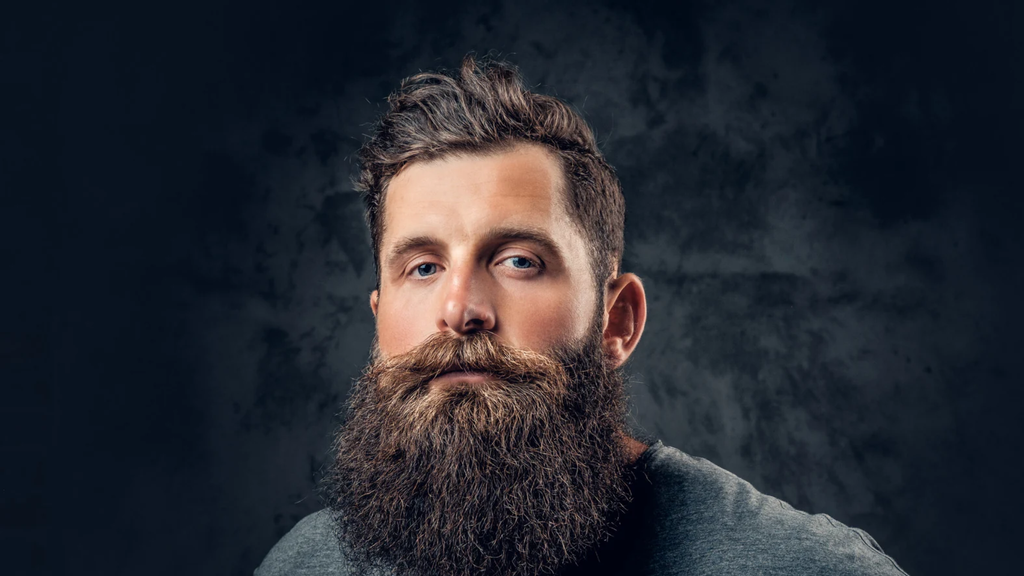
Finally, there’s shape. A wet beard sits flat against the face, so your cheek line and neckline look crisp and exactly where you left them. A dry beard expands outward. Hairs near the edges lift and drift, softening the lines and making the outline look wider or lower.
Ask any barber who’s shaped beards for a living and he’ll tell you the same thing: the outline you see on a wet face is not the outline the world sees.
| What Changes | Wet Beard | Dry Beard |
| Length | Longer, stretched | Shorter, sprung back |
| Volume | Flat, clumped | Full, separated |
| Color | Darker, richer | Lighter, more varied |
| Coverage | Can look patchy | Looks fuller |
| Edges and lines | Sharp, tight | Softer, wider |
| Flyaways | Hidden | Visible |
| Texture | Smooth, sleek | Coarse, natural |
Men have been puzzling over their whiskers for thousands of years, so let’s take a quick trip back before we get into the science.
A Short History of Men and Their Beards
Kings, Taxes and Razors
Beards have always meant something. Wisdom. Power. Rebellion. Sometimes just a man who lost his razor.
The ancient Greeks often linked a full beard with maturity and philosophy. According to the ancient writer Plutarch, Alexander the Great ordered his soldiers to shave, partly so enemies couldn’t grab them by the beard in close combat. It may be the first recorded case of grooming as tactical gear.
In 1698, Russia’s Peter the Great returned from Western Europe determined to modernize his country, and he slapped a tax on beards. Men who wanted to keep theirs had to pay and carry a small token proving they’d done it. Imagine a cop pulling you over to check your beard license.
The Clean-Shaven Century
| Era | Moment in Beard History | What It Meant |
| Ancient Greece | Beards tied to wisdom and age | Facial hair as status |
| Around 330 BC | Alexander orders soldiers to shave | Shaving as practicality |
| 1698 | Peter the Great taxes beards | Beards as political statement |
| 1860 | Grace Bedell, age 11, urges Lincoln to grow whiskers | A beard enters the White House |
| 1904 | King C. Gillette patents the disposable-blade safety razor | Daily home shaving goes mainstream |
| 1914 to 1918 | Soldiers shave for gas mask seals | Clean faces become the norm |
| 1960s to 1970s | Counterculture grows it out | Beards as rebellion |
| 2003 | Movember starts in Melbourne | Facial hair as a cause |
| 2010s to today | Beard revival, oils and balms boom | Beards as craft and identity |
Abraham Lincoln is one of my favorite chapters. In October 1860, an eleven-year-old girl named Grace Bedell wrote to him suggesting he’d look better with whiskers, since his face was so thin. He grew them. He became the first president to wear a beard in office. Every man who’s grown a beard because his daughter or wife asked can relate.
Then came the safety razor. King C. Gillette’s disposable-blade design, patented in 1904, made daily shaving cheap and easy. During World War I, millions of soldiers were issued razors, partly because gas masks sealed better on smooth skin. For much of the twentieth century, a clean face became the default for respectable men.
The Modern Beard Revival
The beard never disappeared, but it went quiet until the 1960s and ’70s, when longer hair and full beards became a symbol of rebellion. Then it faded again in the corporate ’80s and ’90s.
Over the past fifteen years or so, beards came roaring back. Movember, which began in Melbourne in 2003, turned facial hair into a fundraiser for men’s health. Bearded athletes, actors and musicians made the look feel strong and modern. Market research followed the trend: Grand View Research has valued the global beard care products market at well over a billion dollars, driven by oils, balms, washes and tools that barely existed in most men’s cabinets a generation ago.
With all that new attention came a new problem. Men started really looking at their beards, wet and dry, and wondering why they kept changing. To answer that, we need to zoom in on a single hair.
The Anatomy of a Beard Hair
Cuticle, Cortex and Medulla
Every beard hair is built in three layers, a bit like a pencil.
- The cuticle is the outer layer, made of flat, overlapping cells arranged like shingles on a roof. When they lie flat, hair looks smooth and shiny. When they lift, hair looks rough and dull.
- The cortex is the thick middle layer, the wood of the pencil. It holds most of the hair’s strength, its color pigment and the chemical bonds that decide its shape.
- The medulla is the soft core, like the graphite. It’s often present in thicker hairs like beard hair, and sometimes missing in finer hairs.
The cuticle controls how your beard looks. The cortex controls how it behaves. And water reaches both.
Why Beard Hair Isn’t Scalp Hair
If you’ve ever wondered why your beard feels nothing like the hair on your head, you’re not imagining it. Beard hair is a different animal. It’s grown under the influence of androgens, the hormones that kick in during puberty, and it tends to be thicker and more irregular in shape.
| Feature | Scalp Hair | Beard Hair |
| Typical thickness | Finer to medium | Often noticeably coarser |
| Cross-section shape | Varies from round to oval | Often more irregular and flattened |
| Curl tendency | Follows your genetics | Often curlier than your scalp hair |
| Medulla | Sometimes absent | Usually present |
| Natural oil coverage | Scalp oil spreads down the strand | Oil struggles to coat coarse, kinked hair |
| Growth trigger | Present from childhood | Driven by puberty hormones |
| Reaction to drying | Moderate change | Often dramatic change |
Research by Franbourg and colleagues, published in the Journal of the American Academy of Dermatology in 2003, found clear differences in hair diameter and cross-section shape across ethnic groups, from rounder strands to much flatter, more elliptical ones. The flatter and more irregular a strand is, the more it tends to twist and curl. That twisting is a big reason beards spring and puff when they dry.
Here’s something I tell clients all the time. You can have pin-straight hair on your head and a wavy, wiry beard. It’s common. Your face simply grows a different kind of hair.
Follicle Angles and Growth Direction
Hair doesn’t grow straight out of your skin. It exits at an angle, and on your face that angle changes from zone to zone. Cheek hair might grow downward and slightly back. Neck hair often grows sideways or even upward. Chin hair can swirl.
When your beard is wet, the weight of the water drags everything downward, hiding those directions. When it dries, each hair returns to its natural angle. That’s why a beard can look tidy wet and suddenly develop a swirl under the jaw or a cowlick on the chin once it’s dry.
Think of it like a field of wheat after a rainstorm. Flattened in the rain, it all leans the same way. Give it a sunny afternoon and every stalk stands up in its own direction.
So we know what a beard hair is. Now let’s see what happens when water gets inside it.
What Water Does to Your Whiskers
Hydrogen Bonds: The Temporary Glue
Inside the cortex, your hair’s shape is held together by chemical bonds. Two kinds matter most here.
Disulfide bonds are the strong ones. They’re like steel bolts and they don’t budge with water. Chemical relaxers and perms break and reform these, which is why those treatments last until the hair grows out.
Hydrogen bonds are the weak ones. They’re more like Velcro. Water breaks them easily, and they reform as hair dries. Whatever shape your hair is in as those bonds reform is the shape it tends to keep.
| Bond Type | Strength | What Breaks It | What It Means for Your Beard |
| Disulfide | Very strong | Harsh chemicals only | Sets your natural curl pattern |
| Hydrogen | Weak | Water, heat | Lets you reshape while drying |
| Salt bonds | Weak | Changes in pH | Minor shape shifts |
This is the single most important idea in this whole guide. Your beard is reshapeable while wet. The moment it dries, it locks in whatever shape it was in. If you rubbed it every which way with a towel, it locks in chaos. If you brushed it down and guided it, it locks in order.
Swelling, Stretching and Weight
Hair is thirsty. In Chemical and Physical Behavior of Human Hair, the respected hair scientist Clarence Robbins describes how hair can absorb around 30 percent of its own weight in water. As it soaks that water up, each strand swells, growing roughly 15 percent wider while its length increases by only a percent or two.
So a wet beard is literally heavier and each hair is fatter. The swelling pushes cuticle shingles slightly apart, and the extra weight pulls the hair straight down. Picture a soaked wool sweater on a hanger. It stretches, sags and looks longer than it really is. Lay it flat to dry and it pulls back to size.
As water evaporates, the strands shrink back, the weight lifts and the hair returns to its natural bend. That return is the “different” you see in the mirror.
Why Wet Hair Lies Flat
There’s one more force at work: surface tension. Water likes to stick to itself, so when your beard is wet, neighboring hairs glue together in clumps. Those clumps lie flat and tight against your skin.
As your beard dries, the water bridges between hairs break apart. Each hair is suddenly free, and coarse beard hair, with its springy structure, pushes away from its neighbors. That’s where the sudden volume comes from.
It works a lot like a paintbrush. Dip it in water and the bristles form a sharp, narrow point. Let it dry on the windowsill and it fans back out into a fluffy brush.
Knowing the forces is one thing. Watching them play out on a stopwatch is another.
The Drying Process, Minute by Minute
Minutes Zero to Five
Right out of the shower, your beard is saturated. It’s heavy, dark, flat and stretched. This is the most moldable it will ever be. Hydrogen bonds are broken and waiting for instructions.
This is the window that matters most. What you do in these first few minutes, how you towel, comb and apply product, sets up the next hour. I always tell clients to treat these minutes like the first few seconds after the snap in football. Everything that follows depends on how you start the play.
Minutes Five to Twenty
Now the beard is damp, not wet. Water has left the surface but is still inside the strands. Edges start to lift. The ends near your cheeks and neckline dry first, because they’re thinnest and most exposed. You’ll see the beard begin to widen at the sides while the thicker center still looks controlled.
This is also when frizz starts. As the outer layers dry and the cuticle settles, any roughness from towel rubbing shows up as flyaways. If you’re going to apply oil or balm, this damp stage is usually the sweet spot. The hair is still slightly swollen and receptive, but not so wet that the product slides off.
Fully Dry and the Settling Hour
Even when your beard feels dry to the touch, it isn’t quite finished. The core of thick beard hairs can hold moisture for a while longer, especially near the skin where it’s warm and sheltered.
| Stage | Time After Shower | What You See | What to Do |
| Saturated | 0 to 2 minutes | Dark, long, flat, clumped | Gently pat with a towel |
| Wet | 2 to 5 minutes | Still heavy, very moldable | Comb into direction you want |
| Damp | 5 to 20 minutes | Edges lifting, color lightening | Apply oil or balm, brush |
| Surface dry | 20 to 40 minutes | Full volume showing | Light shaping with fingers |
| Fully settled | 40 to 60 minutes | True length, color and shape | Judge your trim here |
That last line deserves bold letters. Your true beard shows up about an hour after your shower. Not before. If you’ve ever judged your beard’s length right out of the bathroom and been surprised by lunchtime, now you know why.
The amount of change you see depends heavily on one thing: how much your beard curls.
Curl, Coil and Shrinkage
Straight Beards vs. Curly Beards
A straight beard changes the least when it dries. It loses a little length, gains a little fluff and lightens a shade. That’s about it.
A curly beard is a whole different show. Each hair coils back on itself as it dries, so the beard can shrink noticeably and widen at the same time.
| Factor | Straight Beard | Wavy Beard | Curly Beard |
| Length change when dry | Minimal | Moderate | Significant |
| Volume increase | Slight | Noticeable | Dramatic |
| Frizz tendency | Low | Moderate | High |
| Visible patchiness when wet | Low | Moderate | Often high |
| Best drying method | Almost anything | Gentle towel, brush | Pat, low heat, leave-in |
| Best trim timing | Damp or dry | Dry | Always dry |
The overall body of a beard, what I call Beard Bulk, can nearly double between wet and dry on a curly beard. That’s not a bad thing. Many men with curly beards look their fullest and most rugged when the beard is dry. The trick is shaping that bulk so it looks intentional instead of accidental.
Coily Beards and Dramatic Shrinkage
Tightly coiled beards experience the most dramatic shrinkage of all. A coil that stretches to two inches might sit at under half that length when dry. That spring is beautiful when it’s healthy, giving a dense, sculpted look that straight beards simply can’t match.
Coily beards also tend to be drier, because natural skin oils have a harder time traveling down a tightly wound strand. Think of trying to slide a bead down a straight string versus a coiled phone cord. The straight string is easy. The coil makes the bead work hard.
That dryness means coily beards often need more moisture, gentler drying and very careful trimming. There’s also a skin concern. The American Osteopathic College of Dermatology notes that pseudofolliculitis barbae, commonly called razor bumps, affects an estimated 45 to 83 percent of Black men who shave. Tightly coiled hair can curve back into the skin, so how you shape and line a coily beard matters for comfort as much as looks.
Mixed Patterns in One Beard
Plenty of men have more than one curl pattern in a single beard. The mustache might be straight, the cheeks wavy and the chin curly. I see it every week.
This is why some beards look uneven when dry even though they were cut evenly. The curly chin shrinks more than the straight cheeks, so the beard looks shorter in the middle. The fix isn’t to fight it. It’s to trim with the dry beard in mind, leaving a bit more length where the hair shrinks most.
| Beard Zone | Common Pattern | Typical Dry Behavior | Trim Adjustment |
| Mustache | Straighter | Drops over the lip | Trim lip line dry |
| Cheeks | Wavy or straight | Widens slightly | Keep cheek line soft |
| Jaw | Wavy | Swirls at the angle | Follow growth direction |
| Chin | Often curliest | Shrinks most | Leave extra length |
| Neck | Mixed, sideways growth | Fuzzy, lifts | Define neckline when dry |
Curl explains a lot of the shape change. But there’s another change that catches men off guard even more: color.
Color, Light and the Gray Hair Factor
Why Wet Beards Look Darker
Your beard doesn’t actually change color when it’s wet. It changes how it handles light.
When hair is dry, light hits the uneven cuticle surface and scatters in many directions. Some of that light bounces back to your eye, so you see the full range of tones in the hair, including lighter and warmer highlights.
When hair is wet, a thin film of water coats each strand and fills the tiny gaps between cuticle cells. That smooths the surface, so less light scatters back toward you and more passes into the hair, where pigment absorbs it. The result looks deeper and darker. It’s the same reason a wet sidewalk looks darker than a dry one, or why a pair of jeans darkens when you spill water on your lap. Nothing changed but the surface.
How Dry Hair Plays With Light
Once dry, a beard shows its true palette. Most beards aren’t one color. They’re a mix. I’d guess the majority of bearded men I’ve worked with have at least some red or blond hairs mixed in, even if their scalp hair is dark brown or black. Those lighter strands disappear when wet and pop when dry.
| Factor | Wet Beard | Dry Beard |
| Overall shade | Darker, uniform | Lighter, varied |
| Red and blond hairs | Mostly hidden | Clearly visible |
| Shine | Glossy | Matte to soft sheen |
| Gray hairs | Blend in | Stand out |
| Patchy areas | Skin shows between clumps | Lighter hairs can make gaps more visible |
Lighting matters too. Bathroom lights are often warm and close, which flatters a wet beard. Daylight from a window is cooler and more honest. If you want to know what your beard really looks like, check it dry, near a window, in the middle of the day.
Gray, White and Wiry Strands
Gray hair deserves its own conversation. Gray and white hairs have lost most of their pigment, so they reflect light strongly when dry and stand out like tinsel on a dark tree.
They also often feel different. Many men notice gray beard hairs are wirier, coarser and more stubborn than their darker neighbors. They tend to stick straight out when dry, ignoring the direction the rest of the beard is heading.
Gray often arrives first in the beard, especially at the chin and corners of the mouth. If you feel like it happened overnight, you’re not alone. A 2012 study by Panhard and colleagues in the British Journal of Dermatology found that only 6 to 23 percent of people worldwide reach 50 percent gray by age 50, debunking the old “half gray by fifty” rule. So graying is gradual and varies widely. It just looks sudden because a wet beard hides it and a dry one reveals it all at once.
Color and curl are built into your hair. But some of the change comes from things outside your body entirely.
Water, Weather and Wash Day
Humidity and Frizz
Hair absorbs moisture from the air, not just from the shower. On humid days, beard hair pulls in water vapor, swells unevenly and breaks some of those hydrogen bonds again. The outer layer of the beard absorbs moisture first and lifts, which is what you see as frizz.
That’s why your beard can look tidy at 7 a.m. and puffy by noon in July. It’s also why a beard that behaves at home can go wild on vacation somewhere tropical. On dry winter days, the opposite happens. Low humidity can make hair brittle and prone to static, so flyaways float up and cling to your scarf.
A light oil or balm acts like a raincoat. It slows the moisture moving in and out of the hair, keeping the shape you set more stable throughout the day.
Hard Water vs. Soft Water
The water coming out of your shower head matters more than most men think. Hard water carries dissolved minerals like calcium and magnesium. A figure widely cited from U.S. Geological Survey data suggests roughly 85 percent of American homes have hard water to some degree.
Those minerals can cling to hair, leaving a dull film that makes beards feel rough and look frizzy when dry. A 2016 study by Luqman and colleagues, published in the International Journal of Trichology, found that hair treated with hard water showed reduced thickness and tensile strength compared with hair treated with distilled water.
| Factor | Hard Water | Soft Water |
| Mineral content | High calcium and magnesium | Low |
| Lather | Weak, needs more product | Rich, rinses fast |
| Residue on hair | Mineral film, dullness | Minimal |
| Dry beard feel | Rough, straw-like | Smoother, softer |
| Frizz | Often worse | Often better |
| Simple fix | Shower filter, clarifying wash weekly | Regular routine works |
If your beard always feels crunchy when it dries no matter what you use, check your water. A shower filter or an occasional clarifying wash can make a bigger difference than any fancy oil.
Shampoo vs. Beard Wash
Here’s a common habit: a man uses the same shampoo on his head and his beard. Totally understandable. It’s right there. But your face and your scalp are different terrain.
| Factor | Regular Shampoo | Beard Wash |
| Cleansing strength | Often strong, built for oily scalp | Usually gentler |
| Effect on facial skin | Can dry and irritate | Designed for face skin |
| Dry beard result | Can feel stripped, frizzy | Softer, more controlled |
| Ideal use | Scalp hair | Beard, a few times a week |
| Cost | Lower | Moderate |
Strong shampoos strip natural oils. On coarse beard hair, which already struggles to get oil from the skin, that stripping leaves strands rough and puffy once dry. Most beards do well with a gentle beard wash two or three times a week and a plain warm water rinse on other days.
Conditioner and Water Temperature
Conditioner is an underrated tool for beards. It coats the cuticle, smooths those shingles back down and helps the beard dry softer and more aligned. A rinse-out conditioner after washing, or a leave-in for curlier beards, can cut frizz noticeably.
Water temperature matters too. A scalding shower feels incredible on a cold morning, but very hot water strips oil from both skin and hair. The American Academy of Dermatology recommends lukewarm water for washing to protect the skin’s moisture barrier. A practical trick: wash with warm water, then finish with a quick splash of cool water on your beard. It won’t magically seal the cuticle, but it will feel refreshing and helps you avoid parboiling your face.
Once you’re out of the shower, how you dry your beard sets the final look.
Towel, Air or Blow Dryer: How You Dry Changes Everything
The Right Way to Towel Dry
Most men dry their beards the way they’d buff a car: hard and fast in circles. That rubbing roughs up the cuticle, tangles the hair and pushes it in every direction just as the hydrogen bonds are about to lock in.
Try this instead:
- Squeeze, don’t scrub. Gently press the towel into your beard to soak up water.
- Pat downward. Follow the direction your beard grows.
- Leave it damp. Stop when it’s no longer dripping.
- Upgrade the towel. A microfiber towel or an old cotton T-shirt causes less friction than a rough bath towel.
It’s a bit like burping a baby. Gentle pats work. Vigorous scrubbing just makes everyone unhappy.
Air Drying: Lazy or Smart?
Air drying gets a reputation as the gentle choice, and it can be. No heat, no friction. For short, straight beards, it’s usually perfectly fine.
But there’s a catch. Air drying is slow, which leaves the beard damp and swollen for a long time. During that window, it’s easily pushed out of shape by your collar, your pillow or your hand resting on your chin while you scroll your phone. Whatever shape it ends up in, it locks.
Interestingly, research supports a more careful approach. A 2011 study by Lee and colleagues in the Annals of Dermatology compared natural drying with hair dryers at different distances and temperatures. They found that using a dryer at about 15 centimeters, or roughly six inches, kept moving continuously, caused less damage than leaving hair to air dry, which showed damage to the internal cell membrane complex. Longer exposure to water, it seems, has its own cost.
Blow Drying Without Frying
A blow dryer, used well, is one of the best tools for taming a beard. It lets you control the direction your beard dries in, which means you control the shape it locks into.
| Method | Speed | Control Over Shape | Damage Risk | Best For |
| Towel rub | Fast | Poor | Moderate to high | Not recommended |
| Towel pat | Moderate | Fair | Low | All beards |
| Air dry | Slow | Poor to fair | Low to moderate | Short, straight beards |
| Blow dry, low heat | Fast | Excellent | Low with care | Medium to long beards |
| Blow dry, high heat close | Very fast | Good | High | Avoid |
Here’s how to do it:
- Pat dry first until damp.
- Set the dryer to low or medium heat and medium speed.
- Hold it about six inches away and keep it moving.
- Point the air downward, the direction you want the beard to fall.
- Brush or comb through as you go.
- Finish with a blast of cool air to help the shape set.
I’ve had men tell me they feel silly blow drying their beard. Then they try it once and wonder how they ever lived without it.
Brush vs. Comb
You’ll get the best results using the right tool at the right moment.
| Factor | Boar Bristle Brush | Wide-Tooth Comb |
| Best for | Short to medium beards | Medium to long or curly beards |
| When to use | Damp to dry | Wet to damp |
| Main job | Distributes oil, smooths surface | Detangles, sets direction |
| Effect on volume | Tames and polishes | Keeps curls defined |
| Risk | Can frizz curly beards | Can snag if teeth are too fine |
For most beards, comb while wet to detangle, then brush when damp or dry to polish. Curly and coily beards often do better with fingers and a pick than with a bristle brush, which can break up curl clumps into frizz.
The right tool sets the shape. The right product keeps it there.
Products That Shape the After-Dry Look
Oil vs. Balm vs. Butter
Every beard product promises the same thing: softness and control. They deliver it in different ways.
| Factor | Beard Oil | Beard Balm | Beard Butter |
| Texture | Liquid | Solid, waxy | Creamy, rich |
| Hold | None | Light to medium | Light |
| Moisture | Light | Moderate | High |
| Best for | Short beards, skin care | Medium beards, flyaways | Dry, curly, coily beards |
| Dry beard effect | Soft, slight sheen | Shaped, tamed | Soft, defined |
| When to apply | Damp or dry | Damp or dry | Damp |
Oil is about the skin and the softness of the hair. Balm adds a touch of beeswax for control, which helps hold the shape you set while drying. Butter is the heavy hitter for moisture, great for beards that dry out quickly.
Many men end up using two: oil for the skin underneath, balm for the shape on top.
Ingredients Worth Knowing
Labels can read like a chemistry exam. Here are the names worth recognizing.
| Ingredient | What It Does | Best For |
| Jojoba oil | Closely resembles skin’s natural oil | Most beards, sensitive skin |
| Argan oil | Softens and adds shine | Dry, coarse beards |
| Shea butter | Deep moisture | Curly and coily beards |
| Beeswax | Light hold and moisture barrier | Flyaways, shaping |
| Coconut oil | Penetrates hair, reduces protein loss | Coarse beards, though heavy for some skin |
| Squalane | Lightweight moisture | Oily or acne-prone skin |
| Aloe vera | Soothes skin | Post-trim irritation |
| Tea tree oil (diluted) | Mild soothing for itch | Itchy beard skin |
Coconut oil deserves a note. Research published by Rele and Mohile in the Journal of Cosmetic Science in 2003 found coconut oil reduced protein loss in hair, likely because it penetrates the shaft better than many oils. That said, it can clog pores for some men, so if you break out, switch to jojoba or squalane.
How Much, When and Where
The biggest product mistake is using too much. More oil doesn’t mean more softness. It means a greasy beard that clumps when dry and attracts every crumb within a mile.
A simple guide:
- Short beard (under half an inch): 2 to 3 drops of oil.
- Medium beard (half inch to two inches): 4 to 6 drops, or a fingernail-sized scoop of balm.
- Long beard (over two inches): 6 to 10 drops, plus balm for shape.
Warm the product between your palms first. Then work it into the skin underneath, not just the surface hairs. Finally, brush or comb it through to distribute evenly. Apply while the beard is damp for the best absorption and the most controlled dry result.
With your beard washed, dried and dressed, there’s one last move that trips men up more than anything else: the trim.
Trimming Wet vs. Trimming Dry
Why Wet Trims Surprise You
I can’t count the number of men who’ve come in with the same sad story. They trimmed in the bathroom right after a shower, steam on the mirror, beard looking long and lush. They took off “just a little.” An hour later, the beard dried, shrank and suddenly looked half as long. A few spots looked patchy. The neckline crept up toward the jaw.
Trimming wet is like measuring a stretched rubber band. You cut where it looks right, then let go, and it snaps back shorter than you planned.
| Factor | Wet Trim | Dry Trim |
| Length accuracy | Poor, hair is stretched | Excellent, true length |
| Shrinkage surprise | Common | Rare |
| Shows curl pattern | No | Yes |
| Shows real shape | No | Yes |
| Neckline accuracy | Can end too high | Lands where you want |
| Ease of cutting | Smoother, hair clumps | Requires combing out |
| Best for | Very straight, short beards | Most beards, especially curly |
The Dry Trim Approach
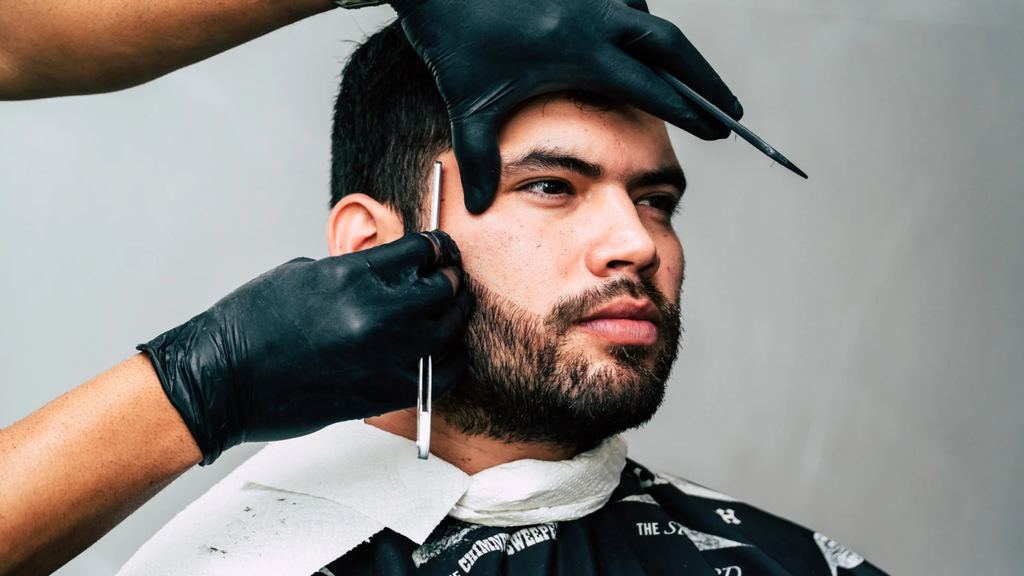
The fix is simple. Trim when your beard is fully dry and has settled, ideally at least an hour after a shower, with your normal product in.
A good home trim looks like this:
- Comb out the beard in the direction it grows.
- Start with a longer guard than you think you need.
- Trim the bulk evenly, cheeks first, then chin.
- Shape the edges last: cheek line, neckline and mustache.
- Step back from the mirror and check from both sides.
- Tidy stray hairs with small scissors.
For the neckline, a common guide is about one to two finger-widths above your Adam’s apple. Set it when dry. If you set it wet, it will look like it’s hugging your jaw by lunchtime.
When to Hand It to a Pro
Some jobs are worth a professional. If your beard has a complex shape, mixed curl patterns, gray strands that stick out or a neckline you can never quite get right, a pro can set the foundation that you then maintain at home.
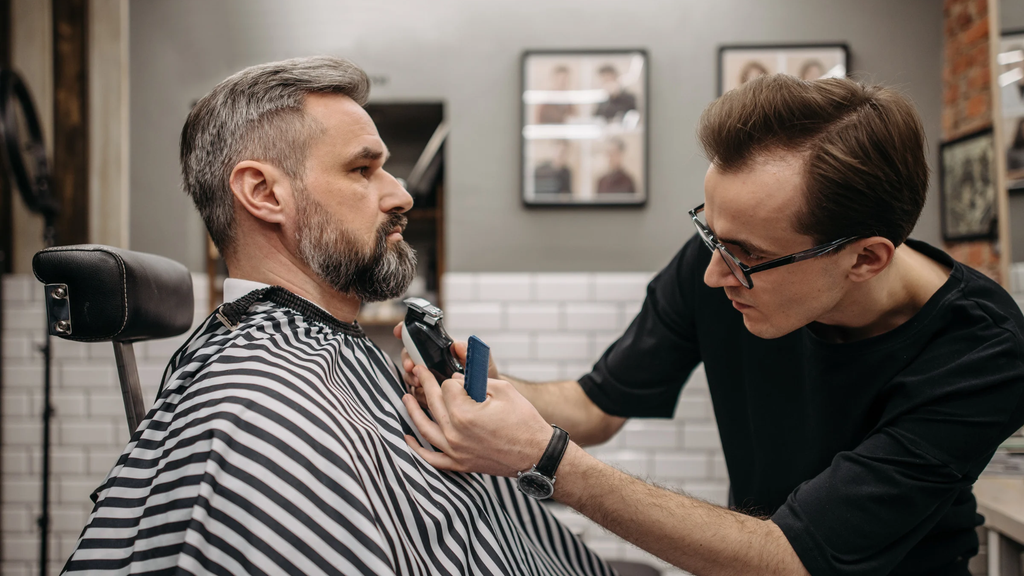
What I do in the chair is mostly about reading the dry beard. I’ll comb it out, look at how each zone wants to fall and trim with that in mind. Curly chins get a bit more length. Cheek lines follow the natural growth instead of fighting it. Necklines get set where they’ll look right all day, not just in the steamy minute after a shower. Then a hot towel, a little balm and a quick brush.
Think of it like a new pair of boots. You can break them in yourself, but a good cobbler makes the fit right from the start.
Even with the right trim, small habits can still sabotage your dry beard. Let’s look at the usual suspects.
Mistakes That Make a Dry Beard Worse
Too Much Heat, Too Much Rubbing
Heat and friction are the two biggest enemies of a smooth dry beard. Scalding showers, high-heat blow drying held close and aggressive towel rubbing all lift the cuticle, and a lifted cuticle means frizz, roughness and dullness once dry.
The sneaky one is hand friction. Many men stroke their beards when thinking. It’s a natural habit, like a pitcher rubbing the ball. But constant stroking while the beard is damp pushes it out of shape, and doing it all day adds wear to the cuticle. Keep the stroking for a dry, oiled beard.
Product Overload
| Mistake | What Happens When Dry | Better Approach |
| Too much oil | Greasy clumps, flat look | Start with fewer drops |
| Too much balm | Stiff, waxy, dull | Pea-sized amount, warm first |
| Layering many products | Buildup, heavy feel | One or two products max |
| Product on soaking wet beard | Slides off, uneven coverage | Apply on damp beard |
| Skipping washes with heavy product | Residue, itch, odor | Wash two to three times weekly |
| Using hair gel in beard | Crunchy, flaky | Use beard balm instead |
Buildup is easy to miss. It looks fine for a few days, then the beard starts drying dull and heavy, almost like it’s carrying a backpack. A good wash with a gentle beard cleanser usually clears it.
Ignoring the Skin Underneath
Your beard grows from skin, and that skin affects how the beard looks dry. Flaky skin under a beard leaves white specks that only show up once the hair dries and separates. Many men call it beard dandruff.
According to a 2010 review in the International Journal of Trichology, dandruff affects roughly half of the world’s adult population at some point, and the same yeast-related flaking can happen in the beard. The American Academy of Dermatology notes that seborrheic dermatitis can appear in the beard area and often responds to medicated cleansers.
Ingrown hairs and bumps under the beard are another issue, especially for men with curly or coily hair. Gentle exfoliation, moisturizing and avoiding very close lines can help. If flakes or bumps stick around for weeks, it’s worth seeing a dermatologist.
Healthy skin underneath makes for a calmer beard on top. And sometimes the best lessons come from the men who learned them the hard way.
Stories From the Chair
The Groom Whose Beard Vanished
He came in four days before his wedding, nearly panicking. His beard, which he’d been growing out for eight months, looked noticeably shorter than he wanted.
“I just took a tiny bit off,” he said. “After my shower. It looked perfect.”
His beard was wavy at the cheeks and curly at the chin. When wet, the chin had hung low and long. He’d trimmed it to match the cheeks. Once dry, the chin shrank back and suddenly looked short and squared off, like someone had taken a bite out of it.
We couldn’t add length back, but we could rebalance. I trimmed the cheeks slightly, softened the chin line and showed him how to blow dry the chin downward with a little balm to stretch it. On his wedding day, it looked full and even. He sent me a photo from the reception with one line: “Never trimming wet again.”
The Swimmer Who Fought the Frizz
A competitive masters swimmer in his forties came in complaining that his beard looked like steel wool. He swam almost every morning.
Chlorine, it turns out, was only part of the problem. He’d also been rinsing with very hot water and rubbing his beard dry with a rough gym towel twice a day. The beard was getting stripped, roughed up and left to dry in a tangle.
We worked out a simple plan. A quick rinse with fresh water right after swimming. A gentle beard wash and conditioner. Pat dry, not rub. Two drops of jojoba oil and a few strokes with a boar bristle brush. Three weeks later, he came back and ran his hand down his beard like he was petting a golden retriever. “Feels like a different beard,” he said. It was the same beard, just treated better.
The Dad Who Thought He Went Gray Overnight
A father in his late thirties came in with his teenage son, who’d booked them both a cut as a birthday gift. While waiting, the dad leaned over and said quietly, “Be honest. Did I go gray this week?”
He hadn’t. He’d recently switched from shaving every few days to letting his beard grow fuller. With more length, the scattered gray hairs on his chin had room to show, and he usually only saw his beard wet after his morning shower, when the grays blended in. One afternoon he caught himself dry in a sunny car mirror and nearly drove off the road.
We talked through options: keep the salt and pepper and shape it well, or trim the chin shorter where the gray clustered. He chose to keep it. His son looked at him and said, “Honestly, Dad, it looks good.” I’ve rarely seen a man sit up straighter in the chair.
Stories like these usually lead to a practical question: what does all this cost?
Cost, Value and Where Beard Care Is Heading
Building a Budget Beard Kit
You don’t need a cabinet full of products to get a great dry beard. A few well-chosen items go a long way.
| Item | Approximate Cost | Why It Matters |
| Gentle beard wash | $10 to $20 | Cleans without stripping |
| Beard conditioner | $10 to $20 | Softens, reduces frizz |
| Beard oil | $10 to $25 | Skin care, softness |
| Beard balm | $10 to $25 | Light hold for shape |
| Boar bristle brush | $10 to $25 | Distributes oil, polishes |
| Wide-tooth comb | $5 to $15 | Detangles wet beard |
| Microfiber towel | $8 to $15 | Gentle drying |
| Trimmer with guards | $30 to $90 | Home maintenance |
| Shower filter (optional) | $20 to $50 | Helps with hard water |
A solid starter kit can come in around $60 to $100, and most products last two to three months. That’s less than a lot of men spend on coffee in a month.
Home Care vs. Professional Care
| Factor | Home Care Only | Home Care Plus Professional Shaping |
| Cost per month | Product costs only | Products plus a trim every 4 to 8 weeks |
| Shape accuracy | Depends on your skill | Professionally set lines |
| Neckline and cheek line | Often drifts over time | Reset regularly |
| Handling mixed curl patterns | Trial and error | Tailored trimming |
| Hot towel and extras | Rare | Often included |
| Best for | Simple short beards | Medium to long or shaped beards |
Professional beard trims vary widely by region and shop, but in many American cities they run somewhere around $15 to $40 on their own, more when paired with a haircut or hot towel service. When you search for a barber near me, look for reviews that mention beard work specifically. Beard shaping is its own skill, and some chairs are much better at it than others.
Gifts That Actually Help
If you’re shopping for a bearded son, dad, partner or friend, think about what happens after the shower.
- For the new beard grower: a starter kit with a gentle wash, oil and a boar bristle brush.
- For the man with a frizzy beard: a quality balm, a microfiber towel and a compact blow dryer with a low heat setting.
- For the man who trims at home: a good trimmer with multiple guards and a small pair of grooming scissors.
- For the dad who never treats himself: a prepaid beard trim with a hot towel service.
One of my favorite gifts I’ve seen was from a young man to his grandfather: a wooden comb with the old man’s initials carved in the handle. The grandfather used it every morning until his last day. Some gifts are about grooming. Some are about remembering who gave them to you.
Trends From Behind the Chair
The beard has grown up. Men aren’t just growing beards anymore. They’re caring for them.
A few trends I’ve noticed:
- Natural texture is in. More men are embracing their curl pattern instead of fighting it, especially with curly and coily beards.
- Gray is getting respect. Salt and pepper beards are being shaped with pride rather than dyed away.
- Skin comes first. Beard care is increasingly about the face underneath, with more men asking about flakes, bumps and sensitivity.
- Fewer, better products. Many guys are moving away from crowded shelves toward a simple routine of wash, oil and balm.
It feels like the beard has gone from a trend to a craft. That’s good news for every man who’s ever been puzzled by the stranger in his post-shower mirror.
Now, let’s tackle the questions that come up most often.
Frequently Asked Questions
Why does my beard look longer when it’s wet?
Water adds weight and relaxes the natural bend in each hair, pulling it straight and stretching it toward its full length. As your beard dries, the hair springs back to its natural shape, which is often wavier or curlier, so it looks shorter. Straight beards change only a little. Curly beards can look much shorter when dry.
Why does my beard look patchy when wet but full when dry?
Wet hairs stick together in clumps, which reveals the skin between them. When the beard dries, the hairs separate and spread out, covering more of your skin. That’s why many men with patchy beards look their fullest when completely dry and lightly brushed.
Should I trim my beard wet or dry?
For most men, dry. Trimming wet means cutting stretched hair, and it will shrink once it dries, often leaving the beard shorter than you planned. Wait at least an hour after showering, comb the beard out and trim it in its natural state. Very short, straight beards are the main exception.
Why does my beard look lighter or redder when it dries?
Water coats each hair and smooths the surface, so less light scatters back to your eye and the beard looks darker. When dry, the hair scatters light normally, revealing its true mix of colors, including red, blond and gray strands that were hiding when wet.
How do I stop my beard from getting frizzy after it dries?
Pat dry instead of rubbing, use lukewarm water, apply a light oil or balm while the beard is damp and consider blow drying on low heat while brushing downward. If you have hard water, a shower filter or an occasional clarifying wash can help remove mineral buildup that makes beards rough.
Is it bad to blow dry my beard?
Not when done carefully. Use low or medium heat, keep the dryer about six inches away and keep it moving. A 2011 study in the Annals of Dermatology found that careful blow drying at a distance caused less damage than leaving hair to air dry. Finish with cool air to help set the shape.
Should I use regular shampoo on my beard?
It’s better to use a gentle beard wash. Many shampoos are designed for an oily scalp and can strip the skin on your face, leaving your beard rough and frizzy when it dries. Wash your beard two to three times a week and rinse with water on other days.
Why do my gray beard hairs stick out when my beard dries?
Gray hairs often feel coarser and wirier than pigmented hairs, so they tend to spring away from the rest of the beard once dry. A small amount of balm can help them lie down, and trimming stray grays with small scissors keeps the beard looking tidy.