
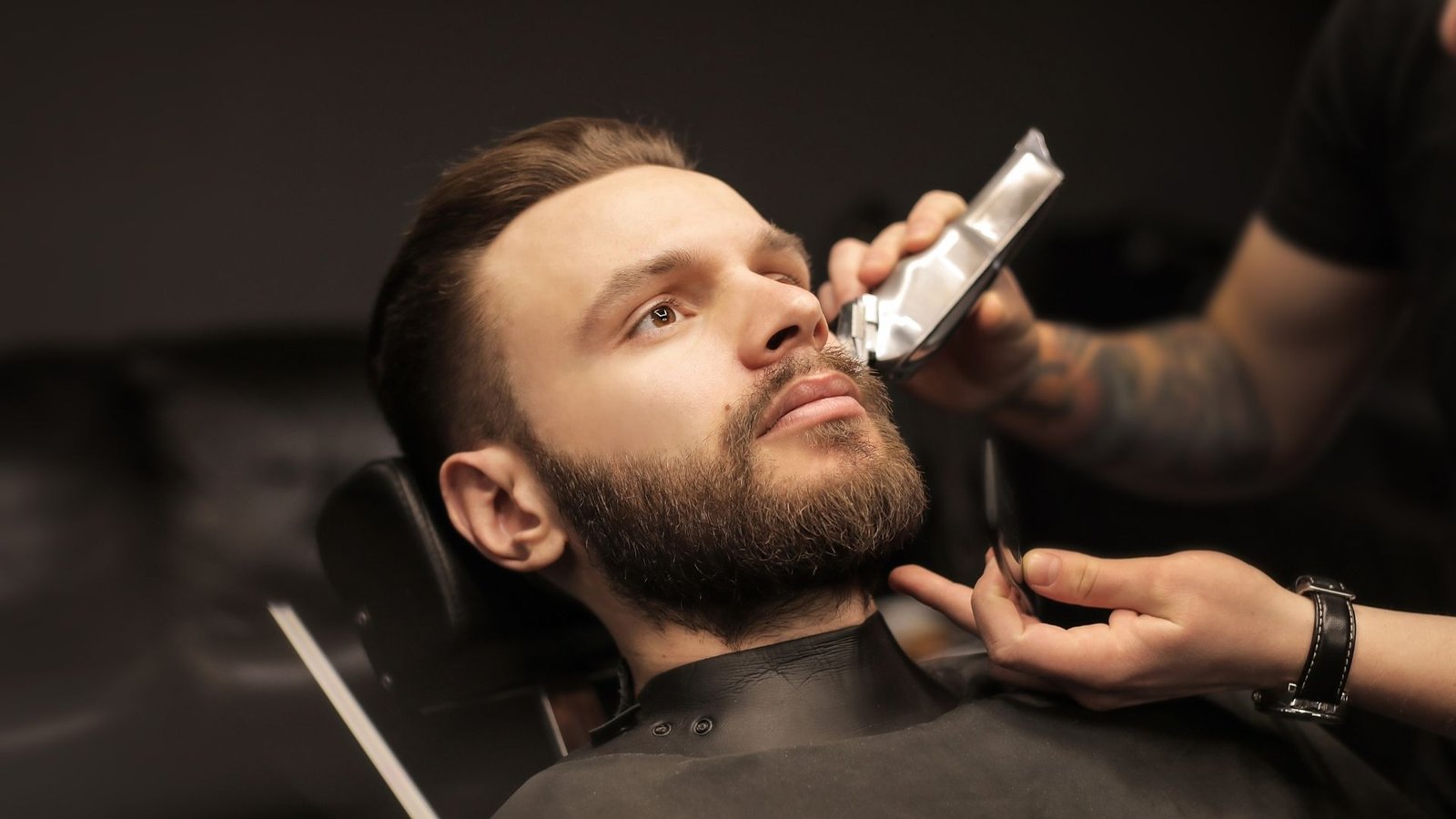
A mismatched haircut, beard, and face shape creates visual imbalance that the eye notices before the brain can explain why. The fix is not a trend or a single “best” style. It is understanding your bone structure, your hair’s natural behavior, and how a haircut and beard must be designed together rather than chosen separately.
When the Mirror Lies to You (Opening Hook)
The moment you realize something looks off
There is a specific moment every man eventually has. You catch your reflection in a store window, or a photo from a wedding lands in your group chat, and something feels wrong. Not bad exactly, just off. Your jaw looks heavier than it should. Your face looks longer, or wider, or somehow unfinished. You cannot name the problem, but you know it is there.
That feeling is not vanity. It is your brain doing what it does best: recognizing patterns and flagging the ones that break symmetry. Faces are the most studied visual pattern humans process, and we are wired to notice when proportions shift even slightly. A haircut that adds width where you already have width, or a beard that lengthens a jaw that is already long, throws off a balance your eye has been reading since childhood.
Why most men never question their look
Most men pick a haircut once, usually in their twenties, and keep returning to the same request out of habit rather than strategy. The barber trims around the edges of that original decision for years. Nobody stops to ask whether the original decision was ever right for the face underneath it.
Part of this comes from how barbershops operate on a time crunch. A fifteen-minute cut does not leave room for a real consultation. Part of it comes from men simply not having the vocabulary to describe what they want changed. “Make it shorter” is not a design brief. It is a guess dressed up as a decision.
What “matching” actually means in barbering
Matching does not mean copying a photo from Pinterest or Instagram and hoping your barber can replicate it. Matching means your haircut, beard, and face shape work as one visual system. The haircut should redirect attention toward your strongest features and away from areas you want to soften. The beard should reinforce that redirection rather than fight it. When those two elements agree with your bone structure, strangers notice that you look sharp, but they could not tell you why.
This is the foundation everything else in this guide builds on. Before you can fix a mismatch, you need to understand the raw material you are actually working with, starting with the shape of your face itself.
Face Shapes 101: What You Are Actually Working With
The seven face shapes and how to identify yours
Barbers and stylists generally sort faces into seven categories: oval, round, square, oblong (also called rectangular), diamond, heart, and triangle. Each shape is defined by the relationship between three measurements: the width of your forehead, the width of your cheekbones, and the width of your jawline, compared against the overall length of your face from hairline to chin.
| Face Shape | Key Traits | Length vs. Width |
| Oval | Balanced forehead and jaw, gently curved | Length slightly greater than width |
| Round | Soft angles, similar width and length | Width and length nearly equal |
| Square | Strong, angular jaw, wide forehead | Width and length similar, sharp corners |
| Oblong | Long face, narrow width throughout | Length noticeably greater than width |
| Diamond | Narrow forehead and jaw, wide cheekbones | Widest point at cheekbones |
| Heart | Wide forehead, narrow pointed chin | Forehead wider than jaw |
| Triangle | Narrow forehead, wide jaw | Jaw wider than forehead |
To find yours, pull your hair back, look straight into a mirror, and trace the outline of your face on the glass with a dry-erase marker, or take a straight-on photo and trace it digitally. Most men are a blend of two shapes rather than a pure textbook example, and that is completely normal.
How bone structure, jaw, and forehead interact
Face shape is really a conversation between three structures: the forehead, the cheekbones, and the jaw. A heavy jaw paired with a narrow forehead reads very differently than the same jaw paired with a wide forehead. This is why two men with “square” faces can need completely different haircuts. One might have a square jaw with a narrow forehead, which calls for added width up top. The other might have width everywhere, which calls for length and softness instead.
Why face shape is only one part of the equation
Face shape gives you a starting point, not a final answer. Hair texture, density, growth pattern, skin tone, and even how your ears sit against your head all factor into the final result. Two men with identical round faces can need entirely different haircuts if one has thick curly hair and the other has thin straight hair. Face shape tells a barber where visual weight needs to shift. Hair type tells them how much control they actually have to shift it.
With your face shape identified, the next question becomes what your haircut is actually doing to that shape, for better or worse.
The Haircut Side of the Equation
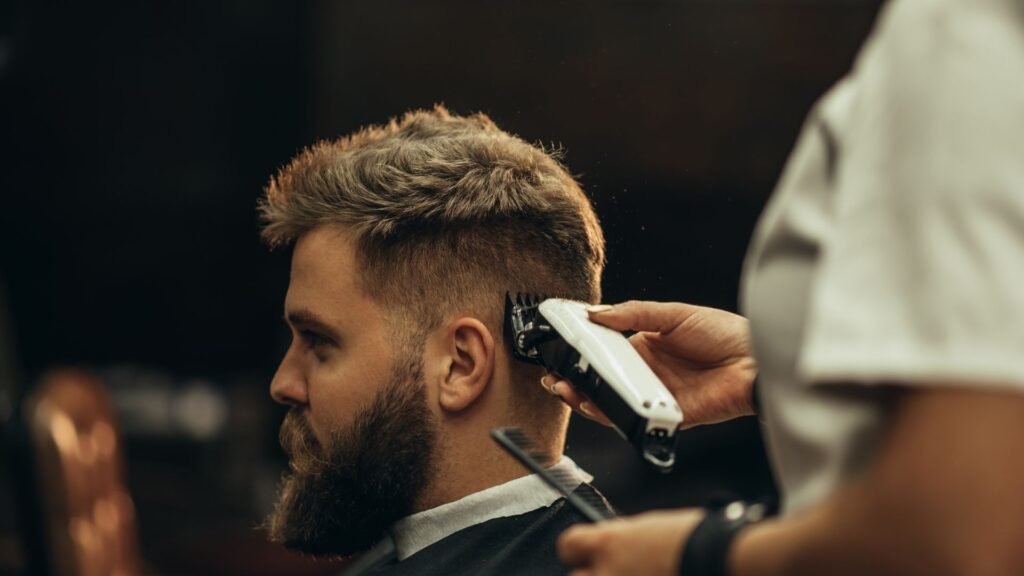
How haircuts add, remove, or redirect visual weight
Every haircut is a weight distribution exercise. Length and volume on top add height, which elongates a face. Width on the sides adds horizontal mass, which can widen a face or balance out a narrow one. Short, tapered sides remove weight from the lower half and push the eye upward. A skilled barber reads your face shape like a sculptor reads a block of stone, deciding where to take material away and where to leave it alone.
The most common haircuts and what face shapes they flatter or fight
| Haircut | Flatters | Fights |
| High fade with textured top | Round, square | Oblong, diamond |
| Low fade with length on top | Oblong, triangle | Round |
| Buzz cut | Oval, oblong | Round, square (can emphasize width) |
| Classic side part | Oval, heart | Round |
| Pompadour | Round, square | Oblong |
| Crew cut | Oval, square | Round |
| Textured crop | Heart, diamond | Square |
| Long slicked back | Oblong (if styled with width) | Long oblong without width |
Why the wrong haircut makes your face look wider, longer, or unbalanced
A buzz cut on a round face removes the one variable, hair volume, that could have added length. The result is a face that reads even rounder than it already is. A high, tight fade on an oblong face strips away the width that face needs, making it look even longer and narrower. These are not aesthetic opinions. They are optical effects that photographers and portrait painters have understood for centuries, long before modern barbering existed.
Hair texture and density: the hidden variable
Thick, dense hair naturally adds volume and visual weight, which can be an asset for a narrow face and a liability for a wide one. Thin, fine hair falls flat and close to the head, which works well for someone who wants a sleek, elongated look but struggles to add width or height when needed. Curly hair behaves unpredictably with length, often shrinking up and adding unexpected width as it dries. A haircut chosen purely from a photo, without accounting for how your specific hair will behave, is a haircut designed for someone else’s head.
Haircuts, though, are only half of the picture for most adult men. The beard is where many of these carefully calculated decisions get quietly undone.
The Beard Factor: How Facial Hair Changes Everything
How beard shape alters perceived face shape
A beard is essentially a second haircut, applied to the lower half of the face, and it has just as much power to reshape perceived proportions. A beard grown fuller along the jawline and tapered at the cheeks can add the illusion of a stronger jaw to a narrow face. A beard kept short and tight along the neckline, with length left on the chin, can visually lengthen a round face. The beard is not a passive accessory sitting below the haircut. It is an active design element.
Beard styles that work against your natural structure
A full, boxy beard on an already square or wide jaw adds mass exactly where there is already too much, creating a heavier, more aggressive look that was likely not the intention. A patchy or very short beard on a long, narrow face adds almost nothing structurally, leaving the length of the face unaddressed. A rounded, soft beard shape on a round face reinforces the very roundness a man might be trying to soften with his haircut above.
The beard and haircut relationship: why they must be designed together
This is where most mismatches actually happen. A man gets a haircut designed to add width to a narrow face, then grows a beard that tapers everything to a point, undoing the width the haircut just created. Or he gets a haircut designed to shorten a long face, then lets his beard grow long on the chin, adding the exact length back that the haircut removed. The haircut and the beard are not two separate decisions. They are one decision, made in two parts, and they need to be planned as a single unit from the start.
Understanding how each piece works on its own sets up the real question: what actually happens, visually and psychologically, when these pieces do not agree with each other.
The Mismatch Problem: What Actually Goes Wrong
Visual imbalance and why the eye notices it immediately
Human faces are processed through pattern recognition that happens faster than conscious thought. Research in visual perception has long shown that symmetry and proportion are among the first things the eye registers in a face, often within a fraction of a second. When a haircut and beard send conflicting signals, one adding width while the other removes it, the overall image reads as unresolved, even if neither element is “wrong” on its own.
Real-world mismatch scenarios (round face, high fade, no beard)
Picture a round face with a high, tight fade and no beard at all. The fade removes width from the sides, which should help, but with no beard to add structure to the jaw, the roundness of the lower face is left completely exposed. The haircut did half a job, and the absence of a beard let the original problem show right through.
When your haircut and beard are both good, but clash with each other
Sometimes each piece is genuinely well executed. A clean, sharp taper. A dense, well-shaped beard. But if the taper was designed for a narrow face and the beard was shaped for a wide one, the final look fights itself. This is the hardest mismatch to diagnose because nothing looks obviously bad up close. It only reads as “something is off” from a distance, which is exactly the feeling described at the start of this guide.
The confidence cost of getting it wrong
There is a real psychological cost to walking around with a look that does not sit right, even if you cannot articulate why. Men report feeling less confident in professional and social settings when they sense their appearance is off, often avoiding photos or front-facing video calls. A haircut and beard that genuinely fit your face do more than look good. They remove a low-grade background anxiety most men do not even realize they are carrying.
With the general mismatch problem established, it helps to go shape by shape and get specific about what actually works and what commonly goes wrong.
Face Shape by Face Shape: The Full Breakdown
Oval face: the flexible standard, and how to still get it wrong
Oval faces are often called the “universal” shape because the balanced proportions between forehead, cheekbones, and jaw mean most haircuts and beard styles work reasonably well. That flexibility leads to a different trap: complacency. Men with oval faces sometimes assume nothing can go wrong, then choose extremes, like an overly boxy beard or an aggressively heavy fringe, that create imbalance where none needed to exist.
Round face: the most common mismatch territory
Round faces benefit from added height and reduced width. Volume on top, shorter sides, and a beard with some length and squared edges along the jaw all help create the illusion of more defined angles. The mismatch trap here is choosing a very short, buzzed cut with no beard, which leaves the roundness fully exposed with nothing to counterbalance it.
Square face: power that needs the right frame
Square faces already have strong definition, and the goal is usually to soften sharp corners slightly rather than add more edge. Textured tops and beards with rounded rather than boxy edges tend to work best. The common mistake is pairing a square jaw with an equally boxy beard and a flat-top style, stacking angle on top of angle until the look feels harsh rather than strong.
Oblong and rectangular faces: length management
These faces need width, not length. Short haircuts with volume on the sides, fuller beards with width along the cheeks, and avoiding tall, vertical styles all help. The common mistake is a long, slicked-back style with a narrow, chin-focused beard, both of which add length to a face that already has plenty.
Diamond, heart, and triangle faces: the underrepresented shapes
These shapes get far less attention in mainstream barbering content, but they are common. Diamond faces benefit from added width at the forehead and jaw through styling and a well-shaped beard, since the cheekbones are already the widest point. Heart-shaped faces benefit from beards with width at the jaw to balance a wider forehead. Triangle faces, with a narrower forehead and wider jaw, benefit from volume up top and a beard kept tighter along the jawline to avoid adding further bottom-heavy weight.
| Face Shape | Best Haircut Direction | Best Beard Direction | Avoid |
| Oval | Most styles work | Most styles work | Extreme, unbalanced choices |
| Round | Height, shorter sides | Squared jaw, some length | Buzz cut with no beard |
| Square | Texture, softer top | Rounded edges | Boxy beard plus flat top |
| Oblong | Width on sides | Fuller, wider beard | Long slicked styles, narrow beards |
| Diamond | Width at forehead and jaw | Fuller at jaw and cheeks | Styles that narrow further |
| Heart | Balanced, not too wide top | Width at the jaw | Very short, patchy beards |
| Triangle | Volume on top | Tighter along jaw | Full, heavy jaw beards |
Face shape is the map, but hair type is the terrain, and the next section explains why the same route can lead to very different destinations.
Hair Type Changes the Rules
Straight hair vs. curly hair: different outcomes from the same cut
Request the exact same haircut on straight hair and curly hair and you will get two different results. Straight hair tends to fall close to the head and emphasize length, which suits elongating styles well but can struggle to add width or volume without product and specific cutting techniques. Curly hair has natural volume and shrinkage, often adding unplanned width and height, which can work beautifully for narrow faces but overwhelm a face that already needs less width.
Thick hair, thin hair, and how density affects silhouette
Thick, dense hair holds shapes well and can support bold, structured styles like pompadours or textured crops. Thin hair often needs shorter lengths and strategic layering to avoid looking flat or sparse, and it typically cannot support the same height or volume without looking artificial.
Coarse, fine, and wavy: the middle ground most barbers navigate daily
Most clients fall somewhere between the extremes, with coarse, fine, or wavy textures that behave differently depending on humidity, growth stage, and product. A good barber adjusts technique based on texture, using point cutting on coarse hair to reduce bulk, or building in layers on fine hair to create the illusion of density.
| Hair Type | Natural Behavior | Best Haircut Approach |
| Straight | Falls flat, emphasizes length | Layering or texture to add volume if needed |
| Curly | Shrinks up, adds width | Length management to control shape |
| Thick | Holds structure well | Can support bold, high-volume styles |
| Thin | Can look flat or sparse | Shorter lengths, strategic layering |
| Coarse | Can look bulky | Point cutting to reduce bulk |
| Wavy | Unpredictable movement | Flexible styles that work with natural flow |
Understanding your own hair type is only useful if your barber knows how to translate that information into technique, which brings us to what actually separates a skilled barber from an average one.
What a Skilled Barber Actually Does Differently
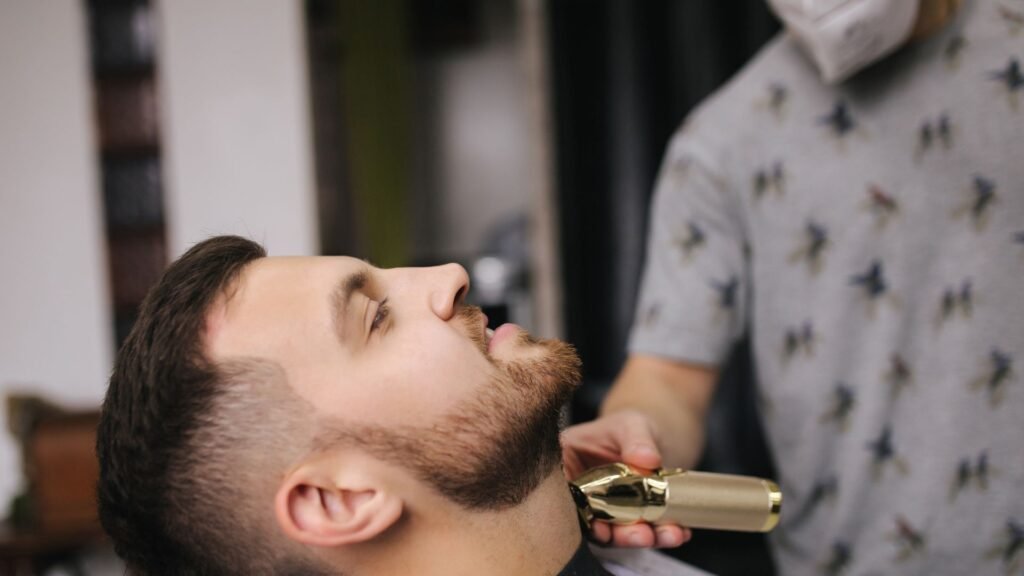
The consultation process: questions most barbers skip
A rushed barber asks “number on the sides?” and starts cutting. A skilled barber asks about your lifestyle, how much time you spend styling your hair each morning, whether you work out and sweat frequently, what has worked or failed for you in the past, and what you actually want people to notice first when they look at you. These questions take two minutes and prevent most mismatches before a single cut is made.
Reading the head shape under the hair
Hair hides the shape of the skull, and skull shape affects how a haircut sits. A flat spot at the back of the head changes how short a cut can go in that area. A prominent crown changes how hair needs to be layered to avoid an awkward cowlick standing straight up. Experienced barbers run their hands through dry hair before cutting specifically to map this terrain.
Designing a unified look across haircut, beard, and face
Rather than treating the haircut and beard as separate services, a skilled barber plans them as one composition. They might intentionally leave extra width in the beard to complement a haircut that adds height, or taper a beard more aggressively because the haircut already added plenty of width on its own.
Why experience matters more than trends
A barber who has cut thousands of heads has effectively run thousands of experiments on how hair type, face shape, and styling interact. That pattern recognition, built over years in the chair, cannot be replicated by a trending tutorial or a photo saved from social media. Trends come and go. Faces and hair types remain constant.
Even with a skilled barber, certain mismatches show up again and again across barbershops for Haircut near me , and recognizing them in advance can save you an awkward few months of grow-out.
The Most Common Mismatches Men Walk Around With
The too-tight fade on a round face
This is likely the single most common mismatch in modern barbering, driven largely by the popularity of high, skin-tight fades across social media. On a round face, removing all width from the sides without adding height or structure elsewhere leaves the roundness with nowhere to hide.
The full beard on an already heavy jawline
A dense, full beard adds mass. On a jaw that is already strong or wide, this often creates a bottom-heavy look that makes the whole face appear heavier than intended, especially in profile or in photos taken from a lower angle.
Long hair on a long face with no width
Letting hair grow long on an already oblong face, especially without layering in width at the sides, stretches the face further and can make features look drawn out or tired, even on a man who is neither.
Short crops with no beard on heart-shaped faces
A heart-shaped face has a wider forehead and narrower chin. Pairing that with a very short crop and no beard leaves the chin area looking underdeveloped compared to the forehead, throwing off the natural balance the face could otherwise have.
| Common Mismatch | Why It Happens | Quick Fix |
| Tight fade, round face | Trend-driven request without consultation | Add height on top, pair with structured beard |
| Full beard, heavy jaw | Beard grown without jaw in mind | Taper beard at the jawline, keep shorter |
| Long hair, long face | No side width added | Layer in width, avoid excess vertical length |
| Short crop, heart face | No chin balance considered | Grow light beard at jawline for balance |
Avoiding these mismatches the first time is far easier than fixing one that has already been growing out for weeks, which is exactly the challenge the next section addresses.
Hair Maintenance and the Mismatch That Grows In
How a good cut falls apart between visits
A sharp haircut on day one can look noticeably different by week four. As hair grows, proportions shift. A fade that was tight and clean against a round face begins to grow out unevenly, softening the structure that was originally built in. Hair Maintenance between visits is not just about keeping things neat. It is about preserving the very proportions the original cut was designed to create.
The grow-out phase and how it shifts your proportions
Most haircuts have a grow-out window of two to four weeks before the original shape starts to distort noticeably. Styles with very short sides and longer tops grow out fastest at the point of contrast, since the sides fill in while the top keeps lengthening, often shifting a once-balanced look toward something unintentionally top-heavy or shapeless.
Maintenance schedules by hair type and style
| Style Type | Recommended Visit Frequency |
| High fade / skin fade | Every 2 to 3 weeks |
| Low fade / taper | Every 3 to 4 weeks |
| Buzz cut | Every 2 to 3 weeks |
| Longer top with short sides | Every 4 to 5 weeks |
| Beard shaping | Every 2 to 3 weeks |
| Full beard trim | Every 3 to 4 weeks |
Staying ahead of grow-out is one way to protect your proportions. Staying ahead of fashion trends that do not suit your face is another, and it is a much harder discipline to practice.
Trends vs. Your Face: When Following Fashion Costs You
Why trending cuts don’t work on every face
Trends are built around whatever look is currently popular among celebrities, athletes, and influencers, most of whom were not selected for their face shape diversity. A trending style might flatter the specific proportions of the person who made it popular while doing nothing for, or actively working against, a different face shape and hair type.
How to adapt a trend to your specific structure
The solution is rarely to abandon a trend entirely. It is to adapt it. A man with a round face who wants a trending textured crop can still get one, just with more height retained on top and a tighter taper on the sides than the original inspiration photo shows. A skilled barber can translate the spirit of a trend into something that respects your actual structure.
The barber’s job when a client wants something that won’t suit them
Part of a barber’s responsibility is honest communication, even when it means pushing back gently on a request. A good barber explains why a specific trend might not translate well to a client’s face and hair type, then offers a modified version that captures the same energy without creating a mismatch.
Trends will keep shifting every few years, but your face shape and hair type are constants. That permanence is exactly why building a true signature look, rather than chasing whatever is popular, pays off over the long run.
Building Your Signature Look: A Practical Guide
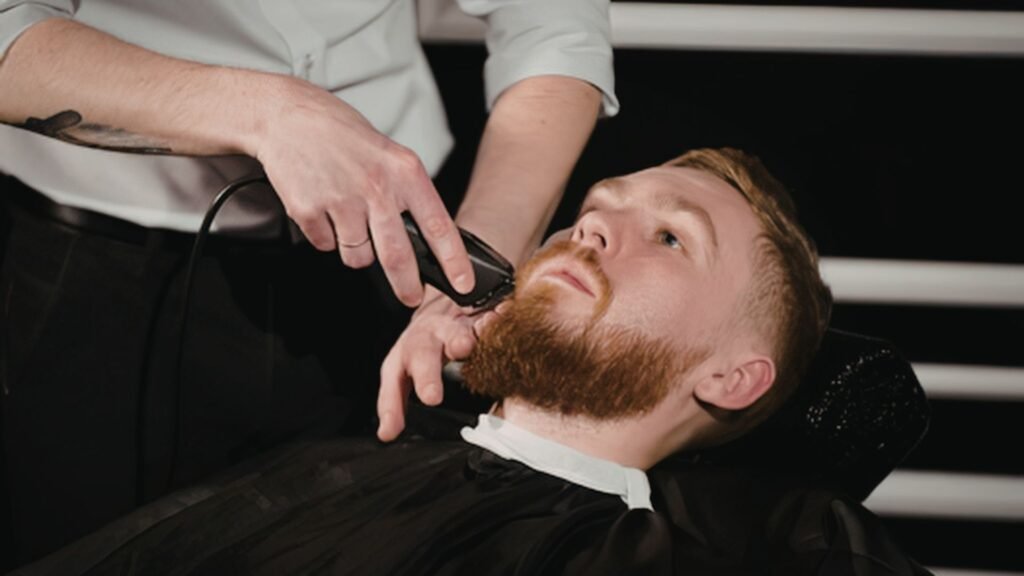
Step-by-step process for identifying your ideal combination
- Identify your face shape using the tracing method described earlier.
- Note your hair type: texture, density, and natural growth pattern.
- Make a list of three to five styles that match both your face shape and hair type from the tables above.
- Bring reference photos, but choose photos of people with a similar face shape and hair type to your own, not simply photos you like aesthetically.
- Discuss lifestyle factors with your barber: how much styling time you realistically have each morning.
- Commit to the chosen style for at least two full maintenance cycles before judging the result, since a new cut often needs one adjustment visit to be fully dialed in.
How to communicate your goals to your barber
Specific language produces specific results. Instead of “shorter,” say “I want more width retained at the temples” or “I want the length reduced by about an inch while keeping the fringe longer.” Bring photos, but also bring the vocabulary from this guide, like face shape and visual weight, so your barber understands the reasoning behind your request, not just the request itself.
Building a look that grows with you: age, weight, lifestyle
Faces change over time. Weight gain or loss shifts jawline definition. Hair naturally thins or recedes with age in many men. A signature look is not a single haircut frozen in time. It is a flexible set of principles about your face shape and hair type that you and your barber revisit and adjust every few years as your proportions shift.
A well-built look is worth protecting, and that protection starts with understanding what you are actually paying for when you book an appointment.
Cost, Value, and Getting What You Pay For
Why cheaper cuts oftencost more over time is simple: inconsistency forces correction. A rushed cut can grow out unevenly, require an earlier cleanup, or leave you buying products to disguise problems that better technique would have prevented.A higher price does not automatically guarantee skill, but it often reflects time, training, consultation, and the ability to reproduce a result reliably. Ask what is included: shampooing, styling guidance, neckline cleanup between visits, or a follow-up adjustment can all change the real value of the service.
Frequently Asked Questions
1. How do I know if my haircut matches my face shape?
Choosing a haircut that complements your face shape involves understanding the proportions and lines of your face. A skilled stylist or barber should guide you based on your bone structure, hair texture, and personal style to create a cohesive look.
2. What are the common mistakes people make when pairing a beard with a haircut?
Common mistakes include not maintaining balance between the length of the haircut and the beard, or not aligning the style of the beard (e.g., rugged, clean-shaven) with the sharpness or softness of the haircut. Proper grooming ensures harmony between the two.
3. Can a poor match between haircut and beard affect overall appearance?
Absolutely. A mismatch can disrupt symmetry and highlight features you may prefer to downplay, whereas the right combination enhances your overall look and adds confidence.
4. How often should I revisit my barber or stylist for maintenance?
Sticking to regular appointments — typically every 4–6 weeks — allows for adjustments and ensures your haircut and beard remain in optimal shape, supporting a polished, consistent appearance.
5. What should I ask my stylist if I’m unsure about my haircut or beard choice?
Be open about your lifestyle, grooming habits, and preferences. Ask for their recommendations on styles that suit your face shape and how to maintain them between visits.
Conclusion
Your haircut, beard, and face shape all play a vital role in presenting your best self. When these elements align, they create a cohesive, polished look that not only enhances your features but also bolsters confidence. Achieving this balance requires open communication with a skilled professional, alongside regular upkeep to tweak your style as needed. A little attention to detail goes a long way in ensuring that your personal grooming reflects the best version of you.